Syringe Blister Packing Machine

Syringe Blister Packing Machine

The Product Geometry, Not the Web, Drives Tooling

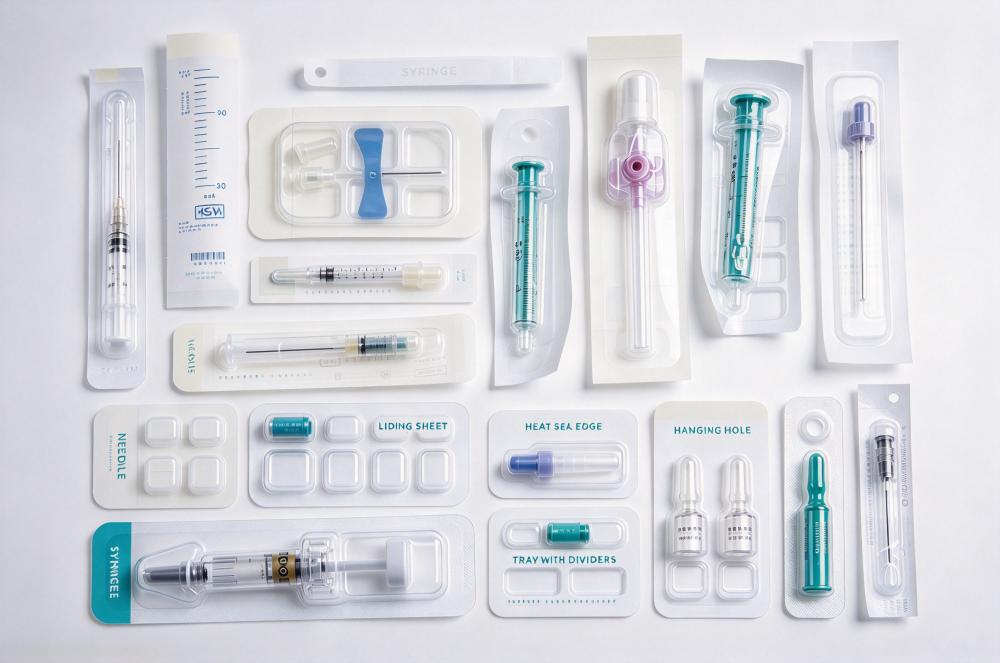
A syringe blister packing machine is specified from the syringe outward — barrel diameter, plunger stop, and needle-shield orientation decide the cavity and feed, and the film is the last thing you choose. Lines that start from a standard tablet blister and try to "drop in" a syringe almost always fight plunger crush, shield pop-off, or a card that will not lie flat. The part defines the tool.
Syringe Blister Packing Machine

Syringe Blister Packing Machine

What Makes a Syringe Different From a Tablet

  • Axis and length. A syringe is long and thin; it needs a cavity that supports the barrel along its length, not a pocket that cradles a disc.
  • Needle shield. The soft shield must be retained without compression that loosens it, and without a formed wall that traps it.
  • Plunger travel. Forming pressure must not push the plunger, or the dose reads wrong on the shelf.
  • Card backing. Syringes ship on a printed card (PE/paper or Tyvek) for hang-sell and instruction print — different from lidding foil.

Feed and Orientation Are the Real Engineering

Syringes are presented loose and must be oriented barrel-down, plunger-up, shield-aligned before the web indexes. Two approaches:

Feed type Speed ceiling Changeover Risk
Vibratory bowl + orienter Moderate Slow (retool) Scuff on barrel
Vision-guided pick-place High Fast (recipe) Higher cost

For a single syringe size at volume, a bowl is fine. For multiple sizes or a clean, scuff-free barrel (premium/pharma), vision-guided pick-and-place pays for itself in rejects saved.

Field Data: A Czech Device Line

A Brno manufacturer of 1 ml prefilled-style syringes for a veterinary product ran a card-backed blister at 60 cards/min but saw 3.1% shield-pop (shield loosened in transit) and 1.4% plunger-push (dose shifted). The cavity had been adapted from a tablet former.

We re-cut the cavity to cradle the barrel on three points, added a shield-retention lip with 0.2 mm clearance, and dropped forming pressure 12% with longer dwell. Outcome:

Metric Before After
Shield-pop rate 3.1% 0.3%
Plunger-push rate 1.4% 0.1%
Card flatness reject 2.0% 0.4%
Speed 60 cards/min 62 cards/min

Tamper evidence: A peelable Tyvek or a perforated card edge is the tamper feature buyers in the EU and US now expect on single-use devices. Build it into the cavity and card die, not as a sticker.

Selection Errors

  • Re-using a tablet cavity. Syringes need length support; a disc pocket crushes the plunger.
  • Ignoring shield retention. The shield is the failure point in transit, not the seal.
  • No plunger-stop verification. Without a vision check, a pushed plunger ships a wrong dose.

Compliance by Region

European Union

EU GMP Annex 1, MDR device labeling, 316L contact, and UDI on the card. Serialization at carton for traceability.

United States

FDA device rules, 21 CFR, and UDI/GTIN. Validation per USP <1207> for the sterile barrier if applicable.

Southeast Asia

Halal where relevant; humid climate favors Tyvek card backing for breathability and seal integrity.

Middle East

GCC/SASO conformity, Arabic label on the card, and tamper-evident edge as retail standard.

Procurement Traps

  • Buying a "blister machine" without confirming syringe-specific cavity design — you will retool.
  • Skipping vision verification of plunger position; manual check does not scale.
  • Omitting the card printer/serializer from the line scope.

Frequently Asked Questions

Can a tablet blister machine pack syringes?

Only with a re-cut cavity and card backing instead of foil lidding. A standard tablet tool will crush the plunger or pop the shield.

Why does my shield come loose in transit?

The cavity wall traps the shield or forming pressure compresses it. A retention lip with clearance and lower pressure fixes it.

Do I need vision inspection?

For any dose-critical or regulated device, yes — plunger position and shield presence must be verified, not assumed.

Tyvek or paper card backing?

Tyvek for sterile or breathable requirements; paper/PE for standard retail. Tyvek costs more but seals cleaner.


Written by Helen Xu | Chief Industrial Application Engineer

Helen Xu is a Chief Industrial Application Engineer with 9 years of specialized experience in packaging machinery and liquid filling machine design, equipment model selection, and full production line process optimization. He focuses on delivering customized packaging & filling solutions for pharmaceutical, food, and chemical manufacturing industries, with mature practical expertise in GMP compliance, ISO 9001 quality management standards, and turnkey large-scale filling & packaging production line integration.

E-mail Us

  • Afghanistan
  • Albania
  • Algeria
  • American Samoa
  • Andorra
  • Angola
  • Anguilla
  • Antarctica
  • Antigua and Barbuda
  • Argentina
  • Armenia
  • Aruba
  • Australia
  • Austria
  • Azerbaijan
  • Bahamas
  • Bahrain
  • Bangladesh
  • Barbados
  • Belarus
  • Belgium
  • Belize
  • Benin
  • Bermuda
  • Bhutan
  • Bolivia
  • Bosnia and Herzegovina
  • Botswana
  • Bouvet Island
  • Brazil
  • British Indian Ocean Territory
  • Brunei Darussalam
  • Bulgaria
  • Burkina Faso
  • Burundi
  • Cambodia
  • Cameroon
  • Canada
  • Cape Verde
  • Cayman Islands
  • Central African Republic
  • Chad
  • Chile
  • China
  • Christmas Island
  • Cocos (Keeling) Islands
  • Colombia
  • Comoros
  • Congo
  • Cook Islands
  • Costa Rica
  • Cote D'Ivoire
  • Croatia
  • Cuba
  • Cyprus
  • Czech Republic
  • Denmark
  • Djibouti
  • Dominica
  • East Timor
  • Ecuador
  • Egypt
  • El Salvador
  • Equatorial Guinea
  • Eritrea
  • Estonia
  • Ethiopia
  • Falkland Islands (Malvinas)
  • Faroe Islands
  • Fiji
  • Finland
  • France, Metropolitan
  • French Guiana
  • French Polynesia
  • Gabon
  • Gambia
  • Georgia
  • Germany
  • Ghana
  • Gibraltar
  • Greece
  • Greenland
  • Grenada
  • Guadeloupe
  • Guam
  • Guatemala
  • Guinea
  • Guinea-Bissau
  • Guyana
  • Haiti
  • Honduras
  • Hong Kong,China
  • Hungary
  • Iceland
  • India
  • Indonesia
  • Iran (Islamic Republic of)
  • Iraq
  • Ireland
  • Israel
  • Italy
  • Jamaica
  • Japan
  • Jordan
  • Kazakhstan
  • Kenya
  • Kiribati
  • North Korea
  • South Korea
  • Kuwait
  • Kyrgyzstan
  • Lao People's Democratic Republic
  • Latvia
  • Lebanon
  • Lesotho
  • Liberia
  • Libyan Arab Jamahiriya
  • Liechtenstein
  • Lithuania
  • Luxembourg
  • Macau
  • Madagascar
  • Malawi
  • Malaysia
  • Maldives
  • Mali
  • Malta
  • Marshall Islands
  • Martinique
  • Mauritania
  • Mauritius
  • Mayotte
  • Mexico
  • Micronesia
  • Moldova
  • Monaco
  • Mongolia
  • Montserrat
  • Morocco
  • Mozambique
  • Myanmar
  • Namibia
  • Nauru
  • Nepal
  • Netherlands
  • New Caledonia
  • New Zealand
  • Nicaragua
  • Niger
  • Nigeria
  • Niue
  • Norfolk Island
  • Northern Mariana Islands
  • Norway
  • Oman
  • Pakistan
  • Palau
  • Panama
  • Papua New Guinea
  • Paraguay
  • Peru
  • Philippines
  • Pitcairn
  • Poland
  • Portugal
  • Puerto Rico
  • Qatar
  • Reunion
  • Romania
  • Russian Federation
  • Rwanda
  • Saint Kitts and Nevis
  • Saint Lucia
  • Saint Vincent and the Grenadines
  • Samoa
  • San Marino
  • Saudi Arabia
  • Senegal
  • Seychelles
  • Sierra Leone
  • Singapore
  • Slovak Republic
  • Slovenia
  • Solomon Islands
  • Somalia
  • South Africa
  • Spain
  • Sri Lanka
  • St. Helena
  • Sudan
  • Suriname
  • Swaziland
  • Sweden
  • Switzerland
  • Syrian Arab Republic
  • Taiwan, China
  • Tajikistan
  • Tanzania
  • Thailand
  • Togo
  • Tokelau
  • Tonga
  • Trinidad and Tobago
  • Tunisia
  • Turkey
  • Turkmenistan
  • Turks and Caicos Islands
  • Tuvalu
  • Uganda
  • Ukraine
  • United Arab Emirates
  • United Kingdom
  • United States
  • Uruguay
  • Uzbekistan
  • Vanuatu
  • Vatican City State (Holy See)
  • Venezuela
  • Viet Nam
  • Virgin Islands (U.S.)
  • Wallis and Futuna Islands
  • Western Sahara
  • Yemen
  • Zambia
  • Zimbabwe
  • Montenegro
  • Serbia
  • Palestine
  • South Sudan
  • Jersey

Chat With Us