
-
E-mail
-
WhatsApp & WeChat
WhatsApp & WeChat
 Blister Packaging Line
 Automatic Counting Machine Line
 Liquid Filling Machine Line
 Powder Filling Machine Line
 Granule Filling Machine Line
 Bag Packing Machine
+86 151 6187 8967
Spices Packing Machine
The single number that decides whether a spice pack still smells like spice at month six is not pouches-per-minute — it is how much volatile oil the machine leaves in the product after dosing, filling and sealing. Most lines that "run fine" on the factory floor still bleed 15–30% of their aroma compounds into the headspace within the first week because the dosing and sealing logic was specified around speed, not around retention.
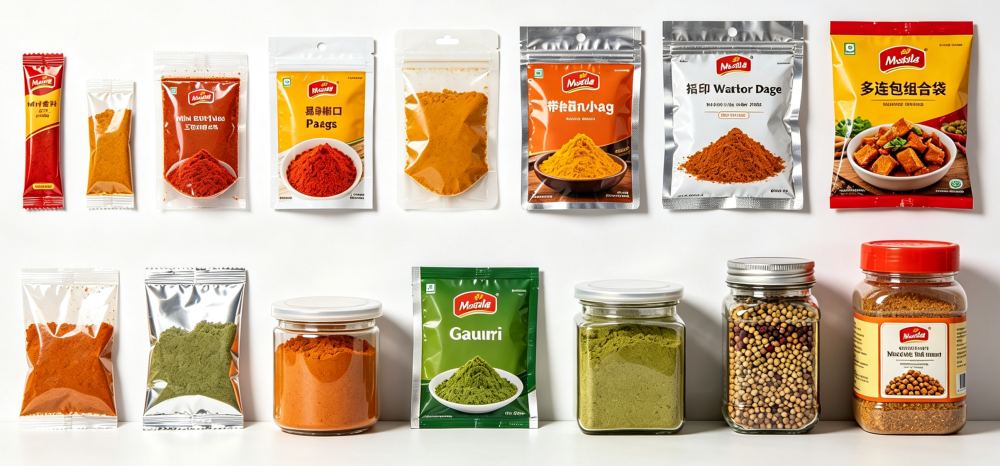
Spices Packing Machine
Ground spice is a hostile product to package. Three failure modes show up in every audit we run:
| Condition during packing | Turmeric volatile-oil retained (28-day, 25°C) | Observed color shift |
|---|---|---|
| Auger at 70°C, no N₂ flush | 61% | Noticeable browning |
| Auger at 38°C, ambient | 78% | Mild fade |
| 38°C, N₂ blanket 4 L/min, metallized film | 91% | None visible |
| 32°C, N₂ 8 L/min, foil laminate, low-IRR ink | 96% | None visible |
The takeaway for procurement: ask the supplier what auger temperature their test ran at, and whether they measured oil retention at all. If the answer is "we hit 60 pouches/min," the machine is probably costing you shelf life.
A spice packer is rarely a single machine. Send this minimum dataset or you will get a price for the wrong line:
A contract packer in Kerala running retail turmeric (400 g pillow pouch) came to us with 9% customer returns for "weak smell" after 3 weeks. Conditions: 31°C, 68% RH monsoon, single-screw auger at 64°C, 38 µm PET/PE film.
We re-spec'd to a twin-pitch auger (coarse 70% / fine 30%) with a 320 ms fine-dwell, dropped auger speed so product exit temperature fell to 36°C, added a 5 L/min nitrogen blanket at the fill throat, and switched to 12 µm MET-PET/PE. Result after 90 days:
| Metric | Before | After |
|---|---|---|
| Line speed | 48 pouches/min | 42 pouches/min |
| Volatile-oil retained (28-day) | 64% | 92% |
| Returns for weak aroma | 9.1% | 0.8% |
| Giveaway at ±1.5% | 2.3% | 0.9% |
They lost 6 pouches/min and gained back a product that survives the shelf. That is the trade every spice buyer should understand before negotiating speed.
Procurement reality: In the Gulf and SEA retail channels, aroma failure shows up as silent shrinkage — the distributor just re-orders less. Specify oil-retention acceptance testing into the FAT, not just a speed trial.
EU GMP Annex 1 expectations for food-contact spice packing push toward 316L product contact, CIP-able hoppers, and full material traceability. Film inks must meet EU 10/2011 migration limits. Organic claims (e.g. certified turmeric) require batch-segregated dosing with clean-out verification.
FDA 21 CFR 175/176 covers food-contact adhesives and coatings; USDA-organic lines need documented non-commingling. ASTA cleanliness specs drive metal-detection and sieve integration upstream.
Halal (JAKIM, MUI, MUIS) certification governs lubricant selection and cleaning-agent records. Humidity control at the filler is the dominant local issue; desiccant hopper purge is standard.
SASO and GCC food-labeling rules require Arabic secondary labeling and often Gulf-standard migration testing on laminate. High summer RH and 45°C warehouse temps make foil laminate the default for premium lines.
Only with a quick-change auger and cup set, and even then expect a 20–30 minute clean-out and re-calibration between products. For mixed SKUs, budget changeover time into your effective daily output.
For pouches with >8-week shelf life in warm retail channels, yes. Without it, capsaicinoid and color loss are measurable within a month.
A well-tuned twin-pitch auger holds ±1% on free-flowing blends and ±1.5–2% on sticky or oily ones. Demand the CV from a 30-bag sample, not a brochure number.
For GCC summer distribution and 12-month shelf life, yes. Metallized film transmits enough oxygen to fade paprika; foil closes that gap.
Written by Helen Xu | Chief Industrial Application Engineer
Helen Xu is a Chief Industrial Application Engineer with 9 years of specialized experience in packaging machinery and liquid filling machine design, equipment model selection, and full production line process optimization. He focuses on delivering customized packaging & filling solutions for pharmaceutical, food, and chemical manufacturing industries, with mature practical expertise in GMP compliance, ISO 9001 quality management standards, and turnkey large-scale filling & packaging production line integration.
E-mail Us
Chat With Us


