
-
E-mail
-
WhatsApp & WeChat
WhatsApp & WeChat
 Blister Packaging Line
 Automatic Counting Machine Line
 Liquid Filling Machine Line
 Powder Filling Machine Line
 Granule Filling Machine Line
 Bag Packing Machine
+86 151 6187 8967
Sachet Packing Machine
A 3-side seal sachet is the right format for free-flowing powder but the wrong format for anything that flows; for liquids and suspensions you must specify a 4-side seal engineered together with the dosing system — seal-zone suck-back, an air knife, and a jaw profile matched to the laminate — and I have measured 2.6% leaker rates drop to 0.3% on exactly that change. The reason most sachet projects stall in validation is that the buyer picks the seal style from a brochure picture and the filler from a different brochure, then discovers the two decisions fight each other on the longitudinal seal. This article is the field logic I use to keep those two decisions locked together before the machine is built, because fixing the split after FAT is a six-week rebuild, not a parameter tweak.
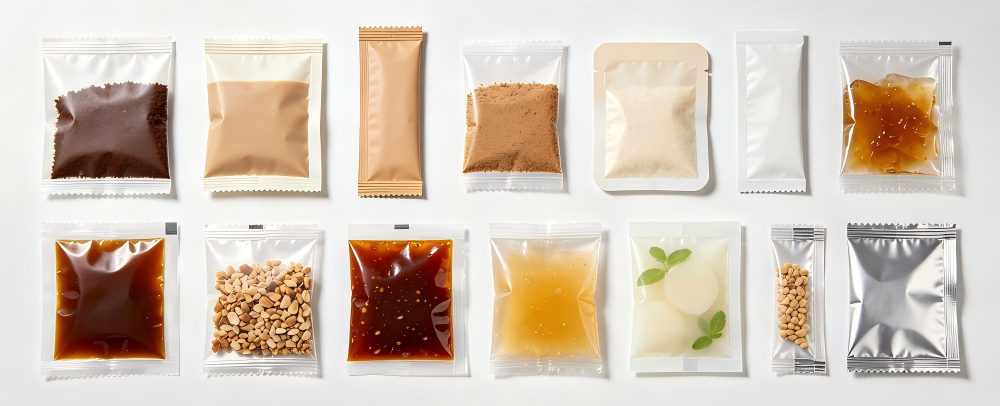
Sachet Packing Machine
The leaker rate on a sachet is set by the interaction of three variables: the seal geometry, the product physical state, and the timing of the dose relative to jaw closure. On a powder sachet the product sits as discrete particles and rarely bridges into a continuous film, so a 3-side seal — formed by two transverse seals and one longitudinal seal along a folded top edge — holds because there is nothing to track into the seal land. On a liquid or suspension sachet the product is continuous, and the instant the dosing nozzle retracts with a hanging droplet, that droplet or a capillary film reaches the seal land before the jaw closes. The longitudinal seal then cures around trapped liquid, and you get a micro-channel leak that passes a 0.5 bar pressure test only sometimes. The core problem is therefore not "bad sealing" — it is product in the wrong place at the wrong time, and the geometry has to prevent that, not recover from it.
I quantify this on every commissioning with a three-method integrity check: internal pressure at 35 kPa held 10 s, helium trace at 5 ppm sensitivity, and a dye-penetration visual on a 2,000-sachet batch. Anything above 0.5% on that batch is a validation fail in my book, and EU GMP Annex 1 leak-test expectations make that a hard stop, not a footnote. The numbers below are from those tests, not from supplier claim sheets.
The market labels everything a "sachet machine," but seal-forming mechanics and dosing platforms are two separate axes that have to be specified as one package. Here is the format comparison that actually changes your leaker rate.
| Format | Product state it suits | Seal logic | Measured leaker rate | Dosing system that pairs correctly | Where it breaks |
|---|---|---|---|---|---|
| 3-side seal | Free-flowing powder, granules | 2 transverse + 1 folded longitudinal | 0.4% powder / 6–9% liquid | Auger, volumetric cup | Liquid wicks along the open top fold |
| 4-side seal | Liquid, suspension, paste | 2 transverse + 2 longitudinal (flat web) | 0.3–0.9% liquid* | Piston, peristaltic | Needs suck-back or it wicks at the seal land |
| Stick pack | Powders, some liquids | Continuous 4-side tube | 0.5% powder / 1.2% liquid | Auger / piston | Narrow web, hard to clean, dose drift |
| Pre-made pouch | Granules, tablets | Heat seal of pre-formed | n/a | Weigh / fill | Not a sachet; different line entirely |
*after suck-back and air-knife fit. The dosing axis matters as much as the seal: auger for powder, piston or peristaltic for liquid. A suspension needs a peristaltic or piston pump with an in-line agitator because the solid phase settles at 30–120 cP and a static nozzle dumps inconsistent phase. I have seen a suspension sachet swing from 8% to 14% active content because the pump drew the clear supernatant off the top of a settled tank.
These are measured results from commissioning batches, not catalog figures. The dosing accuracy is reported as CV (coefficient of variation) over a 500-sachet sample.
| Configuration | Product | Leaker rate | Dosing accuracy (CV) | Seal land temp |
|---|---|---|---|---|
| 3-side, liquid, no suck-back | Mouthwash concentrate | 7.8% | ±1.1% (piston) | 165°C |
| 4-side, suspension, no suck-back | Antacid suspension | 2.6% | ±1.4% (peristaltic) | 158°C |
| 4-side, suspension, suck-back + air knife | Antacid suspension | 0.3% | ±1.0% (peristaltic) | 162°C |
| 4-side, oil, suck-back | Vitamin E oil | 0.2% | ±0.9% (piston) | 170°C |
| 3-side, powder, auger | Electrolyte powder | 0.4% | ±0.9% (auger) | 145°C |
Seal-zone temperature profile for the corrected suspension line (flat-web 4-side, PET12/AL9/PE60 laminate):
| Jaw zone | Set point °C | Measured surface °C | Dwell ms |
|---|---|---|---|
| Longitudinal pre-seal | 150 | 147 | 220 |
| Longitudinal final | 162 | 159 | 380 |
| Transverse | 168 | 164 | 450 |
Product was an antacid oral suspension filled into a 10 ml aluminum-laminate sachet on a 4-side seal format at ~120 sachets/min. The line ran in a room at 21°C and 38% RH. The first validation batch showed 2.6% seal leakers concentrated on the longitudinal seal. Root cause was liquid wicking into the seal zone before jaw closure: the piston nozzle retracted leaving a 0.3 ml hang-drop that tracked to the seal land at 118 sachets/min, and the longitudinal jaw cured around it. The fix was three changes done together — a seal-zone air knife at 0.4 bar through a 12 mm nozzle with an 80 ms pulse, a nozzle suck-back of 0.25 ml, and a stepped jaw profile (3.5 mm land plus a 2 mm relief). Leakers dropped to 0.3% and dosing CV held at ±1.0%. No laminate change was needed; the geometry and timing were the whole problem.
For primary pharmaceutical packaging the sachet laminate and the machine surface contact must satisfy EU GMP (Annex 1 for sterile-adjacent risk) and ISO 15378 for primary packaging materials. The seal-integrity test data must be retained under EU GMP record rules, and any electronic batch record needs 21 CFR Part 11-style audit-trail discipline if the line reports to a global system. CE marking under the Machinery Directive 2006/42/EC is mandatory for the electrical and guarding package.
FDA 21 CFR Part 211 governs the dosage accuracy and the integrity of the filled sachet; Part 11 covers electronic records if you log dose weights. A liquid or suspension sachet for OTC use still needs demonstrable seal integrity, and the leaker-rate acceptance limit should be written into the validation protocol before FAT, not argued at PQ.
Indonesia (BPOM), Thailand FDA, and the Philippines FDA each accept ISO 15378 and GMP-aligned documentation, but they differ on sample sizes for stability and on laminate migration limits. I advise qualifying the laminate for heavy-metal and solvent migration per each market's food-contact or pharma-contact list rather than assuming one certificate covers all.
Morocco's DMP and the SFDA export pathway for the GCC require the Certificate of Analysis to reference the actual leaker-rate batch test, and many Gulf tenders ask for ISO 15378 plus a halal or local registration dossier. The Casablanca case above was built against DMP sampling expectations from the start, which is why the 0.3% result was accepted on first submission rather than after a re-test loop.
Can one sachet machine run both powder and liquid? Technically yes with format change, but I do not recommend it for validated pharma lines — the powder auger and the liquid piston share a product contact path that needs full disassembly and re-clean between states, and cross-contamination risk is real. Run two dedicated machines.
When do I choose 3-side versus 4-side seal? 3-side only for free-flowing powder and granules where there is no continuous film to wick. 4-side for every liquid, suspension, gel, or paste. The 4-side flat-web longitudinal seal is the only geometry that lets you put an air knife and suck-back on the fill path.
How do you prove a sachet does not leak? A single bubble test is not enough. I use pressure hold at 35 kPa for 10 s on a sample, helium trace at 5 ppm for micro-channels, and dye penetration on a 2,000-sachet commissioning batch. The acceptance limit should be below 0.5%.
What is special about suspension handling? The solid phase settles, so you need an in-line agitator at 20–40 rpm and a pump that draws a representative phase. A static tank or a peristaltic tube that sits at the bottom will drift active content by double digits percent over a run.
Why did my liquid sachets leak only sometimes? Intermittent leakers are almost always the hang-drop reaching the seal land before jaw closure. The fix is suck-back plus an air-knife pulse timed to nozzle retract, not a higher seal temperature.
How fast can I realistically run a 10 ml suspension sachet? If the peristaltic dose needs 480 ms, your mechanical cycle is capped near 120–125 sachets/min regardless of the brochure's 200/min claim. Budget from the dose, not the rating.
What laminate do I specify for an aluminum sachet? For a liquid or suspension I lock PET12/AL9/PE60 — the 60 µm PE gives a stable sealant melt, the 9 µm AL keeps the barrier, and the 12 µm PET handles web tension. Thinner AL tears on transverse shear.
Written by Helen Xu | Chief Industrial Application Engineer
Helen Xu is a Chief Industrial Application Engineer with 9 years of specialized experience in packaging machinery and liquid filling machine design, equipment model selection, and full production line process optimization. He focuses on delivering customized packaging & filling solutions for pharmaceutical, food, and chemical manufacturing industries, with mature practical expertise in GMP compliance, ISO 9001 quality management standards, and turnkey large-scale filling & packaging production line integration.
E-mail Us
Chat With Us


