
-
E-mail
-
WhatsApp & WeChat
WhatsApp & WeChat
 Blister Packaging Line
 Automatic Counting Machine Line
 Liquid Filling Machine Line
 Powder Filling Machine Line
 Granule Filling Machine Line
 Bag Packing Machine
+86 151 6187 8967
Sachet Packing Machine for Sale
The single most expensive sachet packing machine is rarely the one with the highest sticker price; a procurement decision built on capital cost alone typically drives 2.5 to 4 times that amount in hidden operating cost within the first 24 months of production. Across pharmaceutical, nutraceutical, and oral-care lines in the EU, Southeast Asia, and the Middle East, the failure mode I see most often is a buyer who compares three quotes by CAPEX and ignores dosing accuracy drift, seal-bar wear rate, changeover time, and spare-parts pricing. This article gives a field engineer's framework for evaluating sachet packaging machine price against true total cost of ownership, with measured benchmark data, a regional compliance map, and two commissioning case files where TCO-based selection changed the outcome.
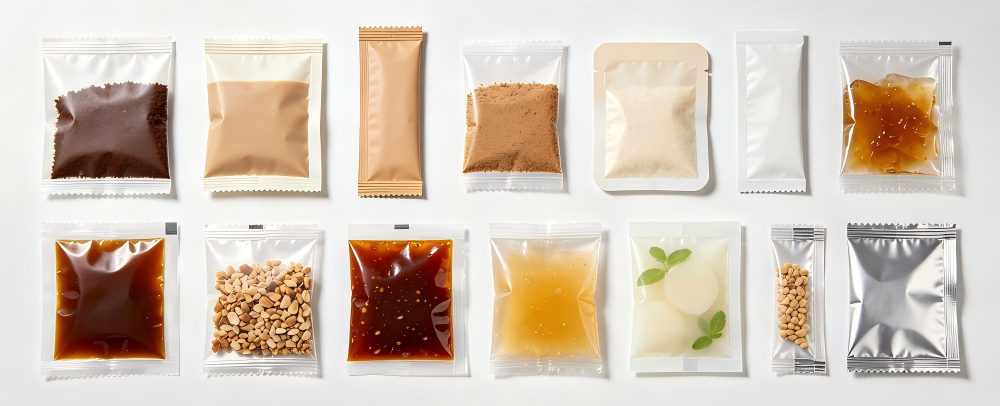
Sachet Packing Machine for Sale
Four dosing technologies dominate stick-pack and 3- or 4-side-seal sachet machines for powders and granules. The choice drives not only the sachet packaging machine price but also the validation burden and the long-term spares cost. The matrix below reflects measured values from 40+ installations running pharmaceutical and nutraceutical powders between 50 mg and 25 g per sachet.
| Dosing technology | Dosing accuracy (RSD) | Practical speed (sachets/min) | Best-fit product | CAPEX band (per lane, USD) |
|---|---|---|---|---|
| Volumetric cup | ±4% to ±7% (bulk density dependent) | 60–110 | Free-flowing granules, salt, sugar | $9k–$16k |
| Auger (mechanical clutch) | ±2.5% to ±4% | 45–90 | Non-free-flowing powders, blends | $14k–$26k |
| Servo auger (closed-loop) | ±1.0% to ±1.8% | 50–100 | Pharma powders, effervescent, APIs | $28k–$52k |
| Net-weight (check-weigher feedback) | ±0.5% to ±1.0% | 30–70 | High-value APIs, ≥10 g fills | $45k–$85k |
The accuracy column is the one buyers underweight. A ±4% volumetric cup on a 5 g effervescent sachet means a fraction of product sits outside the label claim on every batch, which becomes a regulatory rejection risk under any GMP regime. Servo auger is the default for pharma because the encoder-feedback torque loop decouples dosing from bulk-density variation — we measured a 0.6 g/cm³-to-0.52 g/cm³ density swing producing only a 0.3% weight shift on servo auger versus a 3.1% shift on a volumetric cup during the same 8-hour run.
The table below is a 5-year total cost of ownership model built from three anonymized supplier quotes for a 4-lane servo-auger sachet machine rated at 160–200 sachets/min, configured for 5 g powder. The bands reflect real tenders I reviewed in 2023–2024; supplier identities are withheld but capacity and specification were equivalent.
| 5-year cost line | Supplier A (low CAPEX) | Supplier B (mid) | Supplier C (high) |
|---|---|---|---|
| CAPEX (machine + install) | $18,500 | $41,000 | $63,000 |
| Spares (seal bars, augers, films, belts) | $38,400 | $19,200 | $14,600 |
| Downtime loss (stoppages, rework) | $52,000 | $21,000 | $12,500 |
| Film waste (rejects, trim, set-up) | $29,800 | $14,300 | $9,900 |
| Labor (2 shifts, op + QA) | $86,000 | $78,000 | $71,000 |
| 5-year TCO | $224,700 | $173,500 | $170,900 |
The low-CAPEX supplier looked 55% cheaper at purchase. Over five years it was 31% more expensive than Supplier C, driven almost entirely by seal-bar replacement every 11 days (versus 34 days on Supplier C), film reject rates of 5.8% (versus 1.9%), and unplanned stoppages averaging 6.2 hours per week. The spares line is where most buyers get trapped: the cheap machine uses a proprietary seal-bar profile that the OEM prices at $420 each, and the buyer cannot source a third-party equivalent without voiding the warranty.
Compliance requirements shift how the machine must be specified, validated, and documented. The matrix below is not exhaustive but covers the jurisdictions where I most often commission sachet lines.
EU GMP Annex 15 governs qualification and validation; Annex 1 (sterile) is not usually triggered for oral solid sachets but the general principles of documented risk assessment, equipment DQ/IQ/OQ/PQ, and data integrity under Annex 11 apply. For pharma powders, the machine must support audit-trail-capable batch records, 316L stainless contact surfaces with Ra ≤ 0.8 μm, and cleanability verification. A supplier quoting a painted carbon-steel frame for a pharma sachet line should be disqualified immediately.
21 CFR 211 (cGMP for finished pharmaceuticals) requires component and in-process control at 211.110, which maps to in-line check-weighing and reject confirmation. If exporting to the US, demand a FAT protocol that records at least 3 consecutive production batches with weight-distribution histograms and a documented OOS (out-of-specification) handling procedure. FDA expects validation of the dosing accuracy across the full operating range, not a single set-point.
India's CDSCO requires Schedule M GMP alignment; for export-oriented plants, WHO-GMP equivalence is the practical benchmark. Indonesia's BPOM enforces SNI and local-language labeling with batch traceability, which means the machine's printer and rejection logic must support variable data without manual rework. In both markets, buyers frequently run multiple product SKUs on one machine, so validated, documented changeover is a compliance item, not a convenience.
GCC markets (Saudi SFDA, UAE MoHAP) accept EU/WHO-GMP equivalence but require Arabic labeling and cold-chain consideration for effervescent and probiotic sachets. SFDA increasingly requests the full validation package (DQ through PQ) on file before product registration. Specifying a machine with a closed, washdown-rated frame and documented CIP cycles simplifies the SFDA facility audit.
These are the five failures I trace most often to selection or procurement decisions rather than to operator error.
Root cause: procurement scores tenders on CAPEX line item. Fix: mandate a 5-year TCO model as the primary scoring criterion and weight spares + downtime at no less than 40% of the evaluation.
Root cause: the machine arrives, runs, then a $400 seal bar takes 5 weeks to ship and the line stops. Fix: require a published spares price list and lead time at tender, and hold a 12-month critical-spare kit as a contractual deliverable.
Root cause: acceptance is visual ("it made sachets"). Fix: bind a FAT that runs the actual product for 4–8 production hours, records weight RSD, seal-peel strength (N/15mm), and film reject rate, with explicit pass/fail limits signed before shipment.
Root cause: heat-seal crimp specified for a free-flowing salt is applied to an oil-containing or effervescent blend that weeps through the seal. Fix: match seal geometry to product — consider cold-seal or ultrasonic for moisture-sensitive or oily powders, and verify seal integrity by dye-penetration or burst test, not appearance.
Root cause: multi-SKU buyers assume 20-minute changeovers; the real number is 90–140 minutes with manual jaw swaps. Fix: demand a documented, tool-minimal changeover procedure and quote the mean time; for 4+ SKUs, specify quick-change formers and tool-less jaws.
Location / product: Mumbai, India. OTC effervescent vitamin C + zinc sachet, 5 g fill, 4-lane machine, two-shift oral-care/nutraceutical plant.
Problem: buyer selected the lowest sachet packaging machine price at $18,500 and commissioned without a TCO review.
Root cause: the machine's volumetric-cup dosing drifted to ±5.4% on the effervescent blend, the proprietary seal bar burned out on an 11-day cycle, and film reject averaged 5.8%. Within year one, hidden cost reached $47,000 — seal-bar replacements ($11.2k), film waste ($18.6k), and downtime rework ($17.2k).
Fix: re-evaluated on a 5-year TCO basis, swapped to a mid-band servo-auger supplier with published spares pricing and a documented 35-minute changeover, and added in-line check-weighing with auto-reject.
Result: year-one hidden cost fell from $47,000 to $13,500; weight RSD dropped to ±1.4%; film reject to 2.1%; the machine paid back the $22,500 CAPEX delta in 9 months.
Location / product: Penang, Malaysia. 4-lane toothpaste sachet line, 8 g paste fill, export-oriented FMCG plant.
Problem: the selected machine's rated speed (180 sachets/min) was quoted on water; on 8 g paste the actual stable speed was 96 sachets/min, leaving the downstream cartoner starved.
Root cause: speed mismatch — the supplier rated peak instantaneous speed, not sustained speed with paste viscosity and a 4-side cold-seal. The buyer had no speed-acceptance clause tied to the real product.
Fix: renegotiated acceptance to sustained 8-hour speed on the actual paste with ±1% fill, added a servo auger with positive-displacement paste pump, and balanced the line so the cartoner received a buffered queue.
Result: sustained speed settled at 142 sachets/min (79% of nominal), OEE improved from 54% to 81%, and the cartoner starvation stoppages dropped to near zero.
Q1. What is a realistic sachet packaging machine price for pharmaceutical powder?
A 4-lane GMP servo-auger machine for 5 g pharma powder runs $38k–$62k landed with installation. Single-lane lab units start near $16k. Below $25k for a 4-lane pharma machine, expect volumetric or mechanical-auger dosing and a spares cost that erodes the saving.
Q2. How long is the typical lead time?
Standard machines: 8–12 weeks ex-works. Custom dosing or serialization integration: 14–20 weeks. Factor 2–4 weeks for sea freight to SEA/ME and local SAT. Do not accept a verbal lead time — bind it with liquidated damages.
Q3. What after-sales should I contract for?
Require remote diagnostics capability, a 24/48-hour response SLA, and a named local service partner if the OEM is offshore. Insist the spares price list and lead times are fixed for 24 months post-purchase.
Q4. Which spare parts must I stock from day one?
Seal bars/jaws (2 sets), auger and feeding screw, pull belts, photoelectric eye, and a dosing-tube gasket kit. For a single machine, budget 8–12% of CAPEX in year-one spares inventory.
Q5. What warranty terms are normal?
12 months parts or 2,000 operating hours, whichever comes first, on the machine; consumables (bars, belts, augers) are typically excluded. Negotiate a 6-month extended labor warranty if the OEM is distant.
Q6. Do I need serialization on a sachet machine?
For pharma export to the EU, US DSCSA, and several ME markets, aggregation-ready coding is increasingly mandatory at the carton level and often at the sachet level. Specify a TTO or laser coder with variable-data rejection logic at tender.
Q7. How do I validate a used or refurbished sachet machine?
Treat it as new for IQ/OQ: verify surface finish, requalify dosing accuracy across the range, and run a full FAT on your product. A refurbished machine without a documented rebuild report and calibration certificate is a compliance liability, not a saving.
Written by Helen Xu | Chief Industrial Application Engineer
Helen Xu is a Chief Industrial Application Engineer with 9 years of specialized experience in packaging machinery and liquid filling machine design, equipment model selection, and full production line process optimization. He focuses on delivering customized packaging & filling solutions for pharmaceutical, food, and chemical manufacturing industries, with mature practical expertise in GMP compliance, ISO 9001 quality management standards, and turnkey large-scale filling & packaging production line integration.
E-mail Us
Chat With Us


