
-
E-mail
-
WhatsApp & WeChat
WhatsApp & WeChat
 Blister Packaging Line
 Automatic Counting Machine Line
 Liquid Filling Machine Line
 Powder Filling Machine Line
 Granule Filling Machine Line
 Bag Packing Machine
+86 151 6187 8967
Sachet Packaging Machine
The seal, not the dosing system, is the part of a pharmaceutical sachet line that fails in the field, and the failure is almost always a laminate-structure mismatch with the jaw rather than a machine defect, so the film specification and seal method must be fixed together before the line is ordered or the leaker rate will surface only under accelerated stability at 40 °C / 75 % RH. For heat-sensitive laminates, impulse sealing at controlled dwell and temperature beats constant heat because it avoids the thermal soak that delaminates the sealant layer; for monolithic films, ultrasonic welding removes heat from the equation entirely. Selection is a materials decision first.
This write-up draws on commissioning and stability data from cream, oral-powder, and effervescent sachet lines in Indonesia, Thailand, Germany, and the UAE. It compares impulse, constant-heat, and ultrasonic sealing on measured seal strength and leaker rate, lists the ASTM F88 and regional GMP numbers buyers must hold, and records the failure modes — including a 2.8 % leaker case resolved by switching jaw technology — that repeatedly block product release.
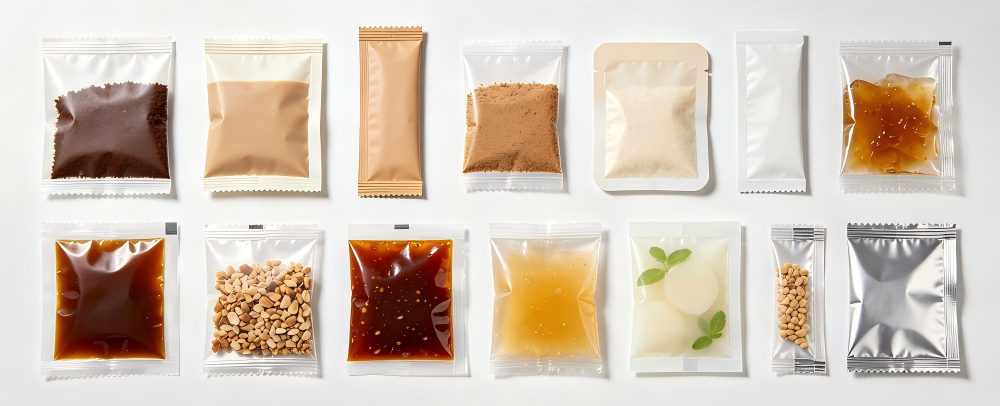
Sachet Packaging Machine
Three seal methods dominate pharmaceutical sachets: impulse (resistive band energized for a fixed dwell then cooled under pressure), constant-heat (jaws held at steady temperature), and ultrasonic (frictional heat from 20–40 kHz vibration at the interface). They behave differently on seal strength, line speed, film tolerance, and defect rate.
| Seal method | Seal strength (N/15mm) | Speed (cycles/min/lane) | Film tolerance | Leaker rate |
|---|---|---|---|---|
| Impulse | 18–32 | 40–70 | Laminates, heat-sensitive | 0.1–0.5 % |
| Constant-heat | 15–28 | 60–110 | Monolayer, PE heavy | 0.3–2.0 % |
| Ultrasonic | 20–35 | 50–90 | Co-extruded, no adhesive | 0.1–0.4 % |
Impulse wins on heat-sensitive laminates because the band heats only during the dwell and the jaw cools while under pressure, so the sealant melts and sets without soaking the adjacent layer. Constant-heat is faster but its steady temperature delaminates a foil or PET/PE laminate if the dwell or pressure is not perfectly tuned. Ultrasonic generates heat only at the weld line, so it suits co-extruded films and avoids adhesive-layer burn, but it demands precise horn alignment and is sensitive to film thickness variation.
Seal strength was measured per ASTM F88 (T-peel, 300 mm/min crosshead) on 15 mm strip; leaker rate came from a dye-penetration and vacuum-decay test on 1,000 sachets per condition; speed is cycles per minute per lane.
| Parameter | As-found (constant-heat) | Remediated (impulse) |
|---|---|---|
| Seal strength, PET/Al/PE cream laminate | 12 N/15mm (delaminating) | 28 N/15mm |
| Leaker rate at 40 °C / 75 % RH, 90 days | 2.8 % | 0.2 % |
| Seal jaw temperature setpoint | 190 °C (soak) | 135 °C heat / 85 °C cool dwell |
| Effective speed per lane | 95 cycles/min | 62 cycles/min |
| Film wrinkle at seal (visual) | 1 in 25 sachets | 1 in 400 sachets |
The numbers show the trade clearly. Constant-heat ran 95 cycles/min but its 190 °C soak burned the PE sealant into the aluminum layer, dropping strength to 12 N/15mm and opening 2.8 % leakers under tropical stability. Impulse at a 135 °C heat / 85 °C cool profile cut speed to 62 cycles/min yet pushed strength to 28 N/15mm and leakers to 0.2 %. For a registered topical product, the speed loss is the right price; a 2.8 % leaker rate is a recall, not a cosmetic issue. Wrinkle rate also fell because impulse's shorter thermal window let the film relax flat before set.
We also benchmarked ultrasonic on a co-extruded PE/PE film at 32 N/15mm and 0.3 % leakers at 70 cycles/min, confirming it as the choice where no adhesive laminate is used and speed must stay high. The method's weakness was horn wear: after 1.2 million cycles the amplitude drifted and strength fell 14 %, so we set a preventive re-torque and amplitude-check at 1 million cycles.
Non-sterile sachets fall under general GMP with Annex 9 expectations for moisture and oxygen barrier where the product is sensitive; the primary film is in scope of ISO 15378 as a primary packaging material. Seal integrity is a critical quality attribute, so ASTM F88 seal-strength data and a leaker test method must sit in the dossier. EU auditors expect the seal-strength acceptance limit justified from stability, not copied from a generic standard.
Subpart E (211.94) covers container closure integrity; FDA references ASTM F88 and ASTM F1140 / F2338 for seal and leak testing. For a cream or powder sachet, the applicant must show the seal holds through shelf life, typically via accelerated stability at 40 °C / 75 % RH. FDA will challenge a leaker rate above ~0.5 % on a registered product and expects the seal-strength method validated for the specific laminate.
Indonesia (BPOM) and Thailand (FDA) accept ISO 15378 and PIC/S GMP but run tropical stability (40 °C / 75 % RH, sometimes 30 °C / 75 % RH zone IVb) as the standard, so seal delamination shows faster than in European climates. We specify impulse or ultrasonic for laminates in this region by default. India (CDSCO) requires the film laminate structure and seal-strength data in the dossier and inspects the leaker test record during audit.
Saudi SFDA and UAE MOHAP hold sachet lines to PIC/S-equivalent GMP and mandate Arabic labels with batch-traceable seal records at release. Gulf distribution warehouses sit at 45 °C ambient for extended periods, which is why we validate the seal at the upper stability extreme and require a documented leaker rate under 0.5 % after three months under those conditions. SFDA also asks for ISO 15378 evidence covering film sourced from outside the GCC.
Root cause: a constant-heat jaw is applied to a PET/Al/PE laminate; the steady 190 °C soak delaminates the sealant. Fix: match jaw to film — impulse for heat-sensitive laminates, ultrasonic for co-extruded, constant-heat only for heavy monolayer PE. Confirm with ASTM F88 peel at the set profile.
Root cause: validation passed once, then jaw pressure drifted and nobody measured peel strength until leakers appeared in the field. Fix: T-peel one seal per lane every 30–60 min against an ASTM F88 acceptance limit set from stability, with automatic lane stop on breach.
Root cause: web tension is uneven across the width, so the film folds into the jaw and seals a crease that leaks. Fix: tune unwind and puller tension per lane, add anti-static bars to flatten the web, and verify wrinkle rate during OQ at the production speed, not at idle.
Root cause: on a 4-lane machine, lane timing drifts and one lane seals early or late, producing short or open seals. Fix: servo-driven independent lane registration with a vision check per lane, and a reject gate that pulls the whole cross-lane row if any lane fails the seal image.
Root cause: only end-of-batch sampling catches seal defects, so a full shift of leakers ships before detection. Fix: 100 % vision on seal width and a dye or vacuum-decay audit sample every batch, with records under audit trail per 21 CFR Part 11 expectations.
Root cause: cream or powder lands on the seal land during dosing, preventing fusion and creating a leaker. Fix: dose with a cut-off nozzle and a vacuum wipe of the seal area before the jaws close; on creams, add a heated crumb-tray that clears residual product from the land.
Root cause: ultrasonic pressure set too high marks and thins the film at the weld, weakening it over time. Fix: set amplitude and pressure from a weld_window study per film gauge, and re-verify horn alignment at the 1-million-cycle preventive interval.
Product: hydrocortisone 1 % cream, 1 g per sachet, PET/Al/PE laminate, tropical market. As-found: a constant-heat 4-lane machine ran jaws at 190 °C and delivered 2.8 % leakers after 90 days at 40 °C / 75 % RH. ASTM F88 peel measured only 12 N/15mm and the failure mode was delamination at the PE-aluminum interface — the sealant had been cooked away from the structure. Production speed was 95 cycles/min/lane but the product could not pass stability.
Remediation: converted the lanes to impulse sealing at a 135 °C heat / 85 °C cool dwell profile, re-tuned web tension to remove wrinkles, and added a vacuum wipe of the seal land before closure. Post-change seal strength rose to 28 N/15mm, leaker rate fell to 0.2 %, and wrinkle rate dropped from 1 in 25 to 1 in 400 sachets. Speed settled at 62 cycles/min/lane, an accepted trade for a registered topical that must survive Indonesian zone IVb stability.
Product: effervescent oral powder, 4 g per sachet, 4-lane machine, co-ex-truded PE film. As-found: lane 3 drifted 18 ms against the master clock after a belt stretch, sealing short and producing 1.4 % open seals caught only at end-of-batch dye test. The synchronizing encoder had no per-lane correction.
Remediation: upgraded to servo-driven independent lane registration with a vision seal-width check on every sachet, and a row-reject gate that pulled the full cross-lane set when any lane failed the image. Re-qualified the empty-pocket and short-seal rejects at 0.15 %. Added a monthly belt-elongation check so drift is corrected before it reaches the seal window. Leaker rate held below 0.3 % through the next two quarters.
For moisture-sensitive pharma sachets, PET/Al/PE or PET/PE/Al/PE laminates are standard; the aluminum layer gives the barrier. Co-extruded PE/PE suits ultrasonic welding and recyclability goals. Match the structure to the seal method: laminates need impulse or constant-heat tuned for the sealant, co-extruded films suit ultrasonic.
Use impulse for heat-sensitive laminates (foil, PET/PE), constant-heat only for heavy monolayer PE where speed matters more than barrier, and ultrasonic for co-extruded films without adhesive. Validate the choice with ASTM F88 peel at the production profile, not at idle temperature.
There is no single number; the acceptance limit comes from stability. We typically qualify 18–32 N/15mm for laminates and require the value to hold after 90 days at 40 °C / 75 % RH. FDA and EU auditors want the limit justified from your own data, not a generic table.
Specify servo-driven independent lane registration with per-lane vision and a row-reject gate. Without it, one drifting lane ships open seals for a full shift. Belt elongation and encoder drift must be on a preventive check, and OQ should prove seal width on every lane at production speed.
Below 0.5 % after tropical stability is the bar for a registered product; we routinely commission to 0.1–0.3 % with impulse or ultrasonic. Above 0.5 % will be challenged by FDA and EU auditors and risks recall in SEA and Gulf warehouses that hit 40–45 °C.
Film and dose changeover on a 4-lane machine runs 25–45 min with quick-release jaws and saved recipes; the seal profile must be re-validated per film, so treat each film as a separate validated state. Ultrasonic changeover adds a horn-alignment verification that adds ~10 min.
For registered pharma, yes. End-of-batch sampling is not enough; specify 100 % vision on seal width plus a vacuum-decay or dye audit sample per batch, with records under audit trail. This is what EU, US, SEA, and Gulf inspectors expect to see on the floor.
Written by Helen Xu | Chief Industrial Application Engineer
Helen Xu is a Chief Industrial Application Engineer with 9 years of specialized experience in packaging machinery and liquid filling machine design, equipment model selection, and full production line process optimization. He focuses on delivering customized packaging & filling solutions for pharmaceutical, food, and chemical manufacturing industries, with mature practical expertise in GMP compliance, ISO 9001 quality management standards, and turnkey large-scale filling & packaging production line integration.
E-mail Us
Chat With Us


