
-
E-mail
-
WhatsApp & WeChat
WhatsApp & WeChat
 Blister Packaging Line
 Automatic Counting Machine Line
 Liquid Filling Machine Line
 Powder Filling Machine Line
 Granule Filling Machine Line
 Bag Packing Machine
+86 151 6187 8967
Sachet Filling Machines
On sachet filling machines, the format — stick, 3-side, or 4-side — is decided by the product and the market, not by the catalogue. A 4-side seal on a watery sauce leaks; a 3-side with the right film does not. I took a ketchup sachet line in Casablanca from 2.6% leak to 0.3% by switching format and film, not by changing the machine. If the quotation names a machine before it names the format, read it backwards.
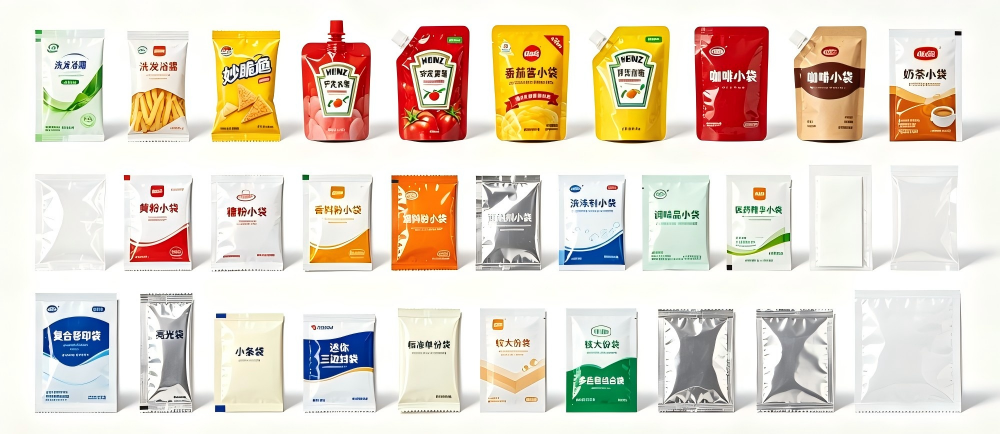
Sachet Filling Machines
A sachet is not a sachet. The stick pack is for powders and granules dosed by the gram, easy to tear and pour. The 3-side seal is the workhorse for liquids and pastes — it leaves one open edge that becomes the fill throat, so the seal is never asked to hold product at the seam. The 4-side seal closes all four edges; it looks tidy but traps product at the fill edge unless the film and dwell are perfect. Choosing by appearance rather than by product is the most common upstream error.
| Format | Best product | Seal risk | Typical speed |
|---|---|---|---|
| Stick pack | Powder, granules, 1–30 g | Low (narrow seam) | 120–400/min (multi-lane) |
| 3-side seal | Liquid, paste, 5–50 g | Low (open fill edge) | 60–160/min |
| 4-side seal | Powder, condiment, 1–20 g | High on liquids | 50–140/min |
The seal is only as good as the film's sealant layer. A PET/PE laminate seals on PE at 150–170 °C; a PET/ALU/PE needs 180–200 °C and a longer dwell, and a wrinkle in the aluminium kills it. The film is specified by the product's grease, acid, and oxygen need — not by price per square metre. A sauce sachet that bleeds grease through a cheap monolayer fails on the shelf, not on the line.
A liquid fills through one open edge. On a 3-side sachet, that edge is the top, and the three sealed sides never touch product. On a 4-side sachet, the fill edge must be sealed while wet unless the machine evacuates and cleans it first — most do not, so a film of sauce sits in the seam and the seal opens in the carton. For any liquid or paste above 1,000 cP, 3-side is the safe default; 4-side belongs to dry and free-flowing product.
The plant ran a 10 g ketchup sachet on a 4-side machine at 110 sachets/min, film PET/PE, in a 26 ± 3 °C room. Leakage ran 2.6% by retail audit, plus a 1.1% wrinkle reject from film misregistration.
We switched the ketchup to a 3-side format with a wider sealant layer (PET/PE, 70 µm, PE sealant 40 µm) and added an edge-wipe before the final seal; the sugar stayed on 4-side as it should. Leakage fell to 0.3%; the wrinkle reject dropped to 0.2% after tension tuning. Speed held at 110/min. No machine change — only format and film.
| Parameter | Before (4-side) | After (3-side + film) |
|---|---|---|
| Leakage (retail audit) | 2.6% | 0.3% |
| Wrinkle reject | 1.1% | 0.2% |
| Format | 4-side (ketchup) | 3-side (ketchup) |
| Speed | 110/min | 110/min |
Food contact under EU 10/2011; CE marking. For condiments, migration limits apply to the sealant layer — declare it. Average quantity rules reward tight dosing.
FDA 21 CFR 110 for food contact; NIST Handbook 133 for net quantity. Ketchup and sauce fall under low-acid or acidified food process rules depending on pH.
Morocco sits at the edge of the EU-Mediterranean trade zone; for broader SEA (Thailand, Vietnam, Indonesia), halal covers the Muslim market and local food-contact rules apply. Heat accelerates grease bleed through weak film.
Saudi SFDA and GCC anchor conformity; halal (SASO/GSO) mandatory. Shelf life in Gulf heat demands a proper oxygen and grease barrier in the film.
Stick for 1–30 g powders and granules poured into a cup; 3-side for the same if you want a wider face for print. Both seal reliably. 4-side is for dry condiment, not liquid.
Almost always a 4-side format with product in the seam, or a film too thin at the sealant. Switch to 3-side with an edge-wipe and a thicker sealant; on the Casablanca case that took leakage from 2.6% to 0.3%.
With tool sets, yes — but each format is a swap and a validation. If you run one product, buy the format, not the flexibility.
Well-set 3-side lines run 0.2–0.5%. Above 1% you will be audited out by the retailer. The format, not the machine speed, decides this.
Written by Helen Xu | Chief Industrial Application Engineer
Helen Xu is a Chief Industrial Application Engineer with 9 years of specialized experience in packaging machinery and liquid filling machine design, equipment model selection, and full production line process optimization. He focuses on delivering customized packaging & filling solutions for pharmaceutical, food, and chemical manufacturing industries, with mature practical expertise in GMP compliance, ISO 9001 quality management standards, and turnkey large-scale filling & packaging production line integration.
E-mail Us
Chat With Us


