


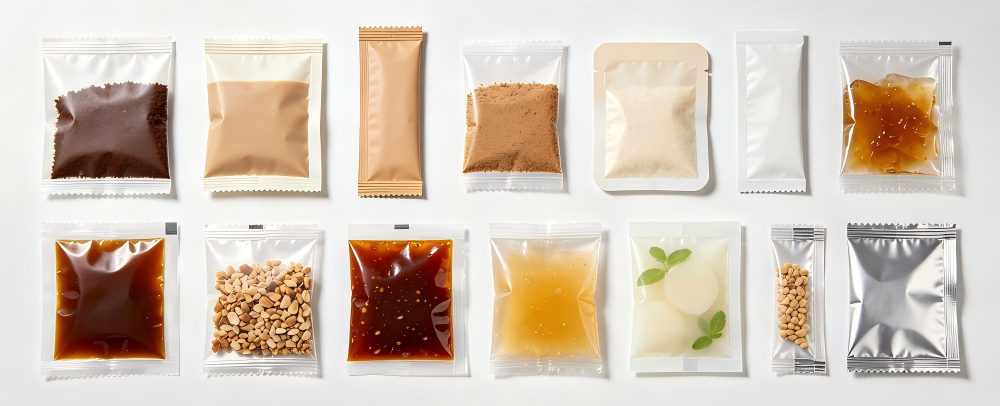


Four numbers that predict how your powder will behave
| Metric | Formula / measure | Interpretation |
|---|---|---|
| Angle of repose | 25–45° | < 30° free-flow; > 40° cohesive |
| Bulk density | g/L as poured | Sets cup / auger size |
| Tapped density | g/L after 100 taps | Settling in sachet |
| Carr index | (tapped−bulk)/tapped × 100 | < 15 easy; 15–25 normal; > 25 hard |
| Hausner ratio | tapped / bulk | < 1.2 free; > 1.4 cohesive |
A 3-in-1 coffee at Carr 12 flows cleanly through an auger; a protein blend at Carr 31 bridges, needs an agitator and a de-aeration step, and still drifts ±1.5 % without checkweighing.
Dosing technologies for powders
| Method | Accuracy | Speed | Dust | Cleaning |
|---|---|---|---|---|
| Volumetric cup | ±1.5 % | High | Low | Easy |
| Augер, no agitator | ±1 % | Medium | Medium | Fair |
| Augер + agitator | ±0.5 % | Medium | Medium | Fair |
| Vacuum / positive auger | ±0.5 % | Medium | Low | Harder |
| Twin-screw | ±0.5 % | Low–med | Medium | Harder |
| Linear / multihead weigher | ±0.3 % | High | High | Easy |
Dust: the root cause of seal failures and downtime
Powder generated at the fill point lands on the seal jaw and breaks the bond. On a 25 g sachet line we measured seal-area dust at 8 mg/m² without extraction; leaks ran 2.4 %. Adding a 250 m³/h hood at the fill and a de-dusting brush before the jaws cut leaks to 0.3 %. Static charging makes it worse in dry Middle East air — a grounded, ionized tunnel is the difference between a clean seal and a reject pile.
- Cross-contamination between batches rides the same dust; treat extraction as a cleaning-control item, not a comfort.
- Seal-through-contamination detection (vision on the jaw) catches the sachets a manual check would miss.
Combustible dust: when ATEX enters the specification
Organic powders — milk, starch, spice, sugar blends — have a minimum ignition energy often below 10 mJ. That puts the dosing and jaw zone into a potential explosive atmosphere where the dust layer exceeds 1 mm or the cloud concentration crosses the lower explosive limit. The buyer must request a real dust hazard analysis, then specify equipment category, grounding and bonded extraction. We supply zone-rated motors and bonded tooling, but the hazard analysis is the buyer's plant responsibility and cannot be assumed.
Sealing with powder in the seal area
- De-dust the sachet neck before the jaw closes — brush or vacuum wipe.
- Jaw profile: serrated crimp for powders that resist a flat seal.
- Leak test: vacuum decay or dye ingress on a sample; target < 5 × 10⁻³ mbar·L/s.
Anonymised case: Middle East ORS producer, 45 °C ambient
A Gulf oral-rehydration-salts line ran 1.9 % leakers in summer. The blend was hygroscopic (water activity 0.35) and bridged at the auger in 45 °C / 20 % RH air that dried the surface then let it clump. Fix: auger with agitator, humidity-controlled feed hopper at 35 % RH, de-dusting brush and serrated jaw. Leakers dropped to 0.2 % and dose drift from ±1.8 % to ±0.6 %.
Compliance
EU GMP for pharma/OTC sachets, 21 CFR 211, ISO 9001, ISO 13485 where medical, FSSC 22000 for food powders, ATEX / IECEx where combustible dust. The cleaning validation must cover powder carryover between batches with a documented swab limit.
Dosing verification and in-process control plan
| Parameter | Method | Frequency | Limit |
|---|---|---|---|
| Fill weight | Checkweigher / sample | 30 min | ±1.0 % |
| Seal integrity | Vacuum decay | 60 min | 0 leakers / 20 |
| Seal-area dust | Vision | Continuous | No powder on jaw |
| Carryover | Swab (ATP) | Per batch | < limit |
Buying mistakes and procurement pitfalls
- Quoting on product name alone, without flow numbers.
- Choosing a volumetric cup for a cohesive blend that needs an agitator.
- Ignoring extraction until dust destroys seals.
- No ATEX statement where the powder is combustible.
- No checkweigher, so dose drift shows up as customer complaints.
FAQ
Which dosing for a cohesive powder?
Augер with agitator, or twin-screw, with checkweighing feedback. A plain volumetric cup will bridge and drift.
Why do my seals leak only in summer?
Humidity swings change flow and dust; hygroscopic blends clump and coat the jaw. Control feed humidity and de-dust before sealing.
Do I need ATEX?
If the powder is combustible (most organics are), run a dust hazard analysis. It sets the zone and the equipment category — do not assume.
How do I verify the seal?
Vacuum-decay or dye-ingress leak test, plus seal-area vision. Target < 5 × 10⁻³ mbar·L/s on a sample plan.
What flow number matters most?
Carr index and Hausner ratio together tell you free-flow vs cohesive; angle of repose confirms handling. Send all three.
Can one machine run salt and protein?
Only with a validated clean between them; powder carryover is a real risk. Budget cleaning time and swab limits.
Why a checkweigher on sachets?
Powder dose drifts with flow and humidity; a checkweigher is the only way to hold ±1 % across a shift.
What humidity should the feed hold?
For hygroscopic blends, 30–40 % RH at the hopper. Dry Middle East air needs active humidification, not just extraction.