
-
E-mail
-
WhatsApp & WeChat
WhatsApp & WeChat
 Blister Packaging Line
 Automatic Counting Machine Line
 Liquid Filling Machine Line
 Powder Filling Machine Line
 Granule Filling Machine Line
 Bag Packing Machine
+86 151 6187 8967
Powder Sachet Filling Machine
If you are filling 5 to 50 g of powder into sachets, an auger dosing head closed-looped to an in-line checkweigher is what holds ±1%; remove that feedback path and you are quietly giving away 2-3% of your product, and no shift report will ever show it. I have spent enough weeks on commissioning floors with a catch-weigh scale to know the pattern: the machine is "in spec", the QA chart is green, and the annual reconciliation is 30 tonnes short. Below is where the dose goes and what we measured on three products once the loop was closed.
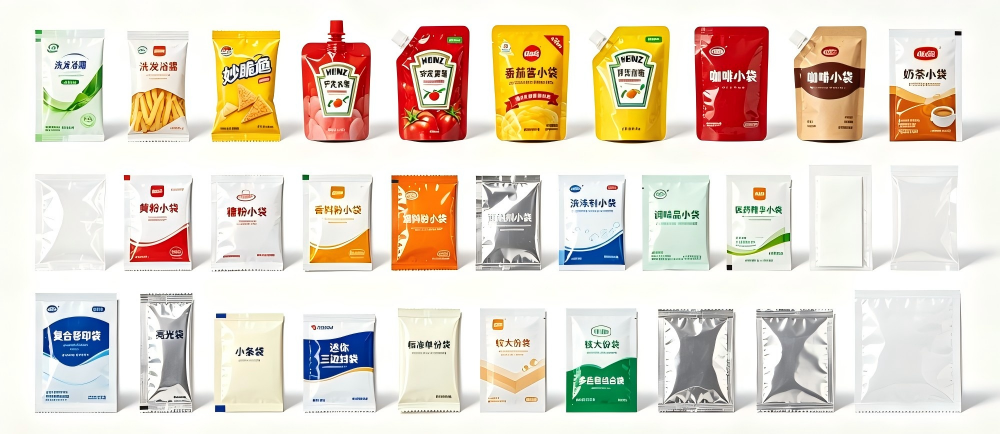
Powder Sachet Filling Machine
Dose accuracy on a sachet line is rarely lost in the servo. It is lost in the powder, which changes during a shift.
Bulk density drift. Powder from a silo or a fresh bag tip is aerated; four hours in an agitated hopper and it de-aerates. On skim milk powder we see 0.44 g/ml at start-up rising to 0.48 g/ml by hour five. An auger doses by volume, so a 9% density swing is a 9% dose swing unless something downstream weighs it.
Auger flight wear. Abrasive fills polish the outside diameter of the flight. After 400-600 hours the OD can drop 0.15-0.25 mm, enough on a 22 mm auger to move the dose 1.5-2.5% low. Nobody notices, because it happens slowly.
Hopper head pressure. A full hopper compacts the powder at the intake; at 15% level the powder arrives loose and each flight carries less. On a 30 g fill we measured a 1.8% difference between full and nearly empty.
Bridging and ratholing. Cohesive powders arch over the intake, then collapse. The dose after a collapse is heavy, then starvation gives three light sachets: a sawtooth on the SPC chart, not a trend.
Electrostatic clinging. Below about 35% RH, fat-containing powders such as coffee creamer charge on the funnel wall and release in lumps. In a heated EU plant in February we measured 22% RH at the filler. The fix is ionised air at the funnel mouth or humidification, not a different auger.
Buyers argue about servo brands and ignore the parameter that governs everything. Dose per revolution scales with flight pitch times the annulus between screw OD and barrel. A 38 mm auger asked to dose 2 g is metering a fraction of a partial revolution; a 12 mm auger asked to dose 100 g takes so many revolutions that it over-shears the powder.
| Fill band | Auger OD | Flight pitch | Flight type | Typical dose time |
|---|---|---|---|---|
| 1-5 g | 12-16 mm | 8-10 mm | Single | 0.35-0.6 s |
| 5-25 g | 22-28 mm | 12-16 mm | Single | 0.5-0.9 s |
| 25-80 g | 32-38 mm | 18-24 mm | Single or double | 0.8-1.4 s |
| 80-250 g | 45-55 mm | 25-32 mm | Double | 1.2-2.0 s |
A double flight halves the revolutions per dose and cuts shear on heat-sensitive creamer. Dose time, not machine speed, caps throughput: eight lanes at 40 cycles per minute give each head 1.5 s, of which the dose must fit inside roughly 60%.
The clutch-brake head is honest and cheap, and wrong for anything under 50 g. Brake wear and coil heating move the stopping angle, and a ±0.5° shaft error on a 22 mm auger at 1.2 revolutions is 0.7% of dose. Day-to-day drift of 1.5-3% is normal, and invisible without weighing.
A servo head removes that error source. A 20-bit encoder resolves 1,048,576 counts per revolution, so the limit becomes coupling backlash and the flight-to-barrel clearance, typically 0.1-0.2 mm. I specify a zero-backlash diaphragm coupling because I have seen a cheap coupling eat the accuracy budget.
Two more items belong in the specification, and both are missing from most quotations:
On a multi-lane machine you have two choices. A single checkweigher downstream of the slitter sees every sachet but cannot tell you which lane made it. Per-lane trim needs a per-lane weigh cell at the cross-seal station or a sequenced divert that maps each sachet back to its lane.
Our default trim: moving average over 10-20 packs, correction step limited to 0.01 revolution, trim authority clamped to ±8% of the nominal count. If the trim parks on the clamp for 60 seconds, the HMI alarms rather than running at the edge. The loop should correct slow density drift and tell you when the powder has genuinely changed.
Default SPC rules: subgroup of 5 on an X-bar/R chart, warning at 2 sigma, action at 3 sigma, plus two consecutive points beyond 2 sigma on the same side. Reject logic is two consecutive out-of-tolerance packs or any pack below the tolerable negative error, with a line stop at three rejects in ten.
The loop corrects the mean, never the spread. If your coefficient of variation is 1.8% because the powder bridges, no amount of trim will deliver 0.5%. Fix flow first, then close the loop.
The table below comes from commissioning trials on a servo-head powder sachet filling machine running per-lane checkweigher feedback. Giveaway is the mean minus the label claim, expressed as a percentage of the claim.
| Product (target) | Mean before | SD / CV before | Mean after | SD / CV after | Giveaway before → after |
|---|---|---|---|---|---|
| Skim milk powder, 25 g | 25.62 g | 0.41 g / 1.60% | 25.09 g | 0.13 g / 0.52% | 2.5% → 0.4% |
| Oral rehydration salt, 20.5 g | 21.10 g | 0.34 g / 1.61% | 20.63 g | 0.12 g / 0.58% | 2.9% → 0.6% |
| Coffee creamer, 12 g | 12.31 g | 0.22 g / 1.79% | 12.04 g | 0.09 g / 0.75% | 2.6% → 0.3% |
Creamer is the instructive row: its spread stayed highest because the product is cohesive and static-prone, and CV only fell below 0.8% after we fitted an ionising blower at the funnel mouth. The powder was the constraint.
Contact parts in AISI 316L at Ra ≤ 0.8 µm, welds ground flush, is our baseline for food and pharma. Ask for the EN 10204 material certificate and a roughness record, not a statement of intent.
An EU customer will ask for a CE declaration of conformity under the Machinery Regulation (EU) 2023/1230, the technical file, the manufacturer's ISO 9001 certificate, and a GMP pack with IQ/OQ protocols, weld maps and cleaning validation support. In practice the inspector spends most of the visit on cleanability and on your own checkweigher calibration records. A US-oriented customer looks harder at material certificates and sanitation design, and at 21 CFR Part 11 expectations for audit trails and user access levels where the filler writes electronic batch records. Specify the documentation language in the purchase order: I have watched a line sit in customs in Latin America because the validation pack was only in Chinese.
A nutraceutical packer in central Europe ran eight lanes at 20 g of a whey and vitamin blend, 38 cycles per minute, two shifts, five days. The plant is heated, so winter relative humidity at the filler fell to 22-26% and the powder clung to the funnel.
We changed four things: load-cell hopper level control with an automatic refill valve, a torque-monitored agitator on an independent drive, per-lane checkweigher feedback with a ±8% clamp, and an ionising blower at the funnel mouth. Over three weeks, mean giveaway fell from 2.7% to 0.4% and the coefficient of variation from 1.7% to 0.55%. At 304 sachets per minute across two shifts and 250 working days that is roughly 33 tonnes of product a year no longer leaving in the customer's pocket.
A beverage-powder packer we support in the Gulf runs the same platform at 45 °C ambient. There the constraints change: derated drives, a rated cabinet air conditioner rather than a fan, chilled water for the sealing jaws, and the checkweigher shielded from the dust collector's air stream.
What accuracy can I actually hold at 5 g?
On a free-flowing powder with a 22 mm servo head and checkweigher feedback, expect a standard deviation of 0.06-0.09 g and a CV of 1.2-1.8%. Below 2 g the CV degrades sharply; you need a 12-16 mm auger plus per-lane weighing, or a different pack size.
Do I need a checkweigher on every lane?
Not always. A single downstream checkweigher is enough if the lanes are well matched and you only need aggregate control and rejection. Per-lane trim earns its cost above roughly four lanes.
How many sachets per minute should I specify?
Work backwards from dose time. Eight lanes at 40 cycles per minute is a sensible ceiling for 5-25 g; above that, dose time pushes you to fewer lanes. Any quotation promising 60 cycles on a cohesive fill deserves a FAT with your own powder.
What change parts does a second fill weight need?
Auger, funnel, and the forming tube and seal jaws for the new sachet width. Insist the quotation lists them with prices; this is the most common budget overrun on sachet projects.
Can a powder sachet filling machine handle sticky or hygroscopic powder?
Only with the right upstream conditions: dehumidified feed air, a heated hopper jacket, polished contact surfaces. We ask for a 25 kg sample and run it on our own head before quoting a tolerance.
What about FAT and SAT?
Insist on a FAT with your powder and film over at least 30 minutes. Agree SAT criteria (mean, SD, CV, giveaway, reject rate) in the contract, and confirm who supplies calibration weights and the local service engineer.
Written by Helen Xu | Chief Industrial Application Engineer
Helen Xu is a Chief Industrial Application Engineer with 9 years of specialized experience in packaging machinery and liquid filling machine design, equipment model selection, and full production line process optimization. He focuses on delivering customized packaging & filling solutions for pharmaceutical, food, and chemical manufacturing industries, with mature practical expertise in GMP compliance, ISO 9001 quality management standards, and turnkey large-scale filling & packaging production line integration.
E-mail Us
Chat With Us


