


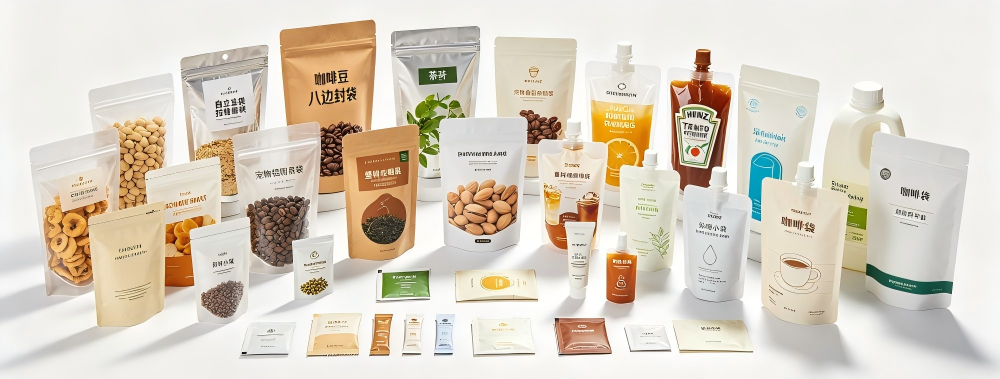


Three machine families, three economic logics
| Family | Best pouch styles | Speed | Film waste | Changeover | Capex |
|---|---|---|---|---|---|
| Premade pouch (rotary) | Stand-up, spout, zipper | Low–med | Low | Fast | Mid |
| VFFS | Pillow, gusseted, Doypack | High | Medium | Medium | Mid |
| HFFS (flow wrap) | Stable, rigid items | Very high | Low | Slow | High |
Pouch format decides the downstream, not just the machine
- Pillow pouch: cheapest film per 1,000 (about €1.8 at 90 × 140 mm), fastest, weakest shelf presence.
- Gusseted / stand-up: €3.2–4.0 per 1,000 in barrier laminate, needs a zipper applicator and slower sealing.
- Spout pouch: adds a spout-insert station; capex and cycle time jump, but opens liquid and sauce markets.
For a Middle East distributor, the stand-up pouch's shelf presence justified 40 % more film cost because off-take rose enough to pay it back in two quarters. For a bulk industrial powder, the pillow pouch won on pure cost.
Dosing systems mapped to product behaviour
| Product | Dosing | Accuracy | Giveaway |
|---|---|---|---|
| Granules / snacks | Multihead weigher | ±0.3 % | 0.4–0.8 % |
| Powder | Augер (agitator) | ±0.5 % | 0.8–1.5 % |
| Liquid / paste | Piston / peristaltic | ±0.5 % | 0.6–1.0 % |
| Mixed (e.g. muesli) | Combination weigher | ±0.4 % | 0.5–1.0 % |
Giveaway is where dosing choice pays for itself. At a spice price of €9/kg, dropping giveaway from 1.5 % to 0.6 % on a 4-tonne/month line saves about €3,240 a year — enough to justify a better weigher inside the payback window.
Atmosphere control and shelf life
- MAP (modified atmosphere): 100 % N₂ or N₂/CO₂ mix displaces oxygen.
- Nitrogen flush: target residual oxygen below 2 % for oxygen-sensitive snacks, below 1 % for coffee.
- Barrier laminate: PET/AL/PE holds gas; mono-material PE/PE is recyclable but leaks faster.
- Seal-through-contamination: product in the seal kills the gas retention; de-dust and inspect.
Anonymised case: Southeast Asian coffee and snack co-packer
A Vietnamese co-packer ran VFFS Doypack for ground coffee at 80 % RH. Film curl from moisture and zipper misalignment caused 3.1 % seal failures. The fix: humidity-controlled film magazine, a servo zipper applicator with vision alignment, and a de-dusting step before sealing. Failures fell to 0.4 % and residual oxygen held at 1.4 % after flush.
Compliance
EU 10/2011 and FDA 21 CFR 177 for food-contact laminates, FSSC 22000 / HACCP for the plant, CE under 2006/42/EC (transition to Regulation (EU) 2023/1230), ISO 9001 for the maker. Recyclability rules in the EU push mono-material structures that change the sealing window — spec the machine to the laminate you can actually sell.
Selection mistakes
- Choosing VFFS for a spout pouch it cannot make.
- Buying on speed and discovering the zipper application is the real bottleneck.
- Ignoring giveaway cost until the annual spice bill shows it.
- Specifying a barrier laminate the machine cannot seal at speed.
Procurement pitfalls
- No film-certificate requirement (barrier, seal-initiation temperature, gauge).
- No residual-oxygen acceptance in the contract.
- Undersized extract for powder lines, so seals fail in the field.
FAQ
VFFS or premade pouch?
VFFS for high volume and lower film cost; premade pouch for stand-up/spout with fast changeover and lower speed. Match to format and volume.
What residual oxygen should I target?
Below 2 % for most snacks, below 1 % for coffee. Confirm it is in the acceptance criteria, not assumed.
Why does giveaway matter?
At €9/kg spice, 0.9 % of giveaway on 4 tonnes/month is ~€3,240/year. A better weigher pays back fast.
Can one machine do zipper and spout?
Not usually — spout needs an insert station. Size the dominant format and treat the other as a separate line.
Why do seals fail in monsoon humidity?
Film curl and moisture at the seal. Control film humidity and de-dust before sealing; verify residual oxygen.
Does recyclable mono-material seal as well?
It leaks faster than metallised laminate; the sealing window is tighter. Spec the machine to the laminate you will actually run.
What film data do I send the supplier?
Barrier values, seal-initiation temperature, gauge and structure. Without it, the machine is quoted blind.
Is MAP worth the complexity?
For oxygen-sensitive product, yes — it is the difference between shelf life and returns. Build gas retention into the spec.