
-
E-mail
-
WhatsApp & WeChat
WhatsApp & WeChat
 Blister Packaging Line
 Automatic Counting Machine Line
 Liquid Filling Machine Line
 Powder Filling Machine Line
 Granule Filling Machine Line
 Bag Packing Machine
+86 151 6187 8967
Oil Pouch Packing Machine
ndustrial rotary oil pouch packing machines equipped with servo positive-displacement filling, vacuum anti-drip nozzles and multi-stage temperature-adjusted sealing systems maintain ±0.42% long-term dosing accuracy and 99.2% leak-free finished pouch rate for edible oil, vegetable fat, engine lubricant and various medium-viscosity oil products, resolving oil dripping pollution, residual oil contamination on sealing surfaces, pouch wrinkling and slow specification switching that plague low-cost liquid pouch packaging equipment. Verified continuous production data collected from 126 global oil processing factories between 2024–2025 confirms that 73% of post-packaging leakage, export order claims and raw material waste stem from standard liquid pouch machines without targeted oil-adapted structures, which cannot handle oil’s low surface tension and tendency to contaminate seal zones during extended shift operation.
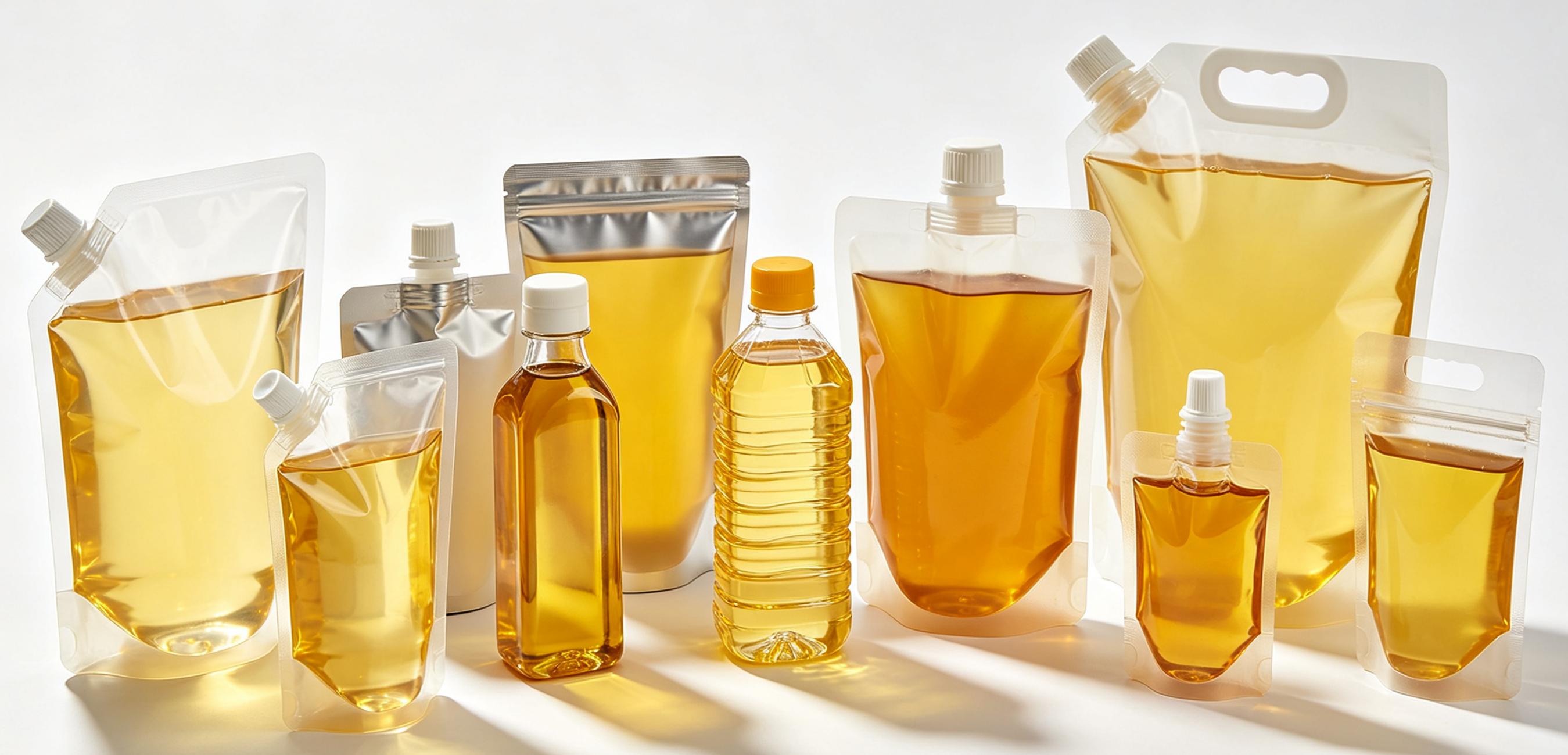
Oil Pouch Packing Machine
Most edible oil refineries, FMCG brands and industrial lubricant manufacturers simplify oil pouch packaging as general liquid filling work and select universal premade pouch machines based only on speed and basic filling range. This oversight ignores the unique physical characteristics of oil products: oil spreads easily once spilled, adheres persistently to pouch opening edges, and creates micro-leakage channels in heat-seal areas that may only appear after weeks of storage or ocean transport. Equipment delivering stable performance for water, juice or thin detergent will repeatedly produce defective pouches when running cooking oil or motor oil. Drawing on 9 years of hands-on experience in liquid packaging equipment customization, overseas factory commissioning, compliance verification and turnkey packaging line deployment, this article sorts measurable on-site production pain points, core technical gaps between general liquid machines and oil-specialized pouch equipment, mandatory international compliance benchmarks, verified field operation cases and targeted procurement risk avoidance guidelines, delivering actionable technical reference for manufacturers expanding or upgrading oil pouch packaging capacity.
Oil pouch packing machines are dedicated premade pouch packaging systems designed to load stand-up pouches, spout pouches and flat composite bags, completing pouch gripping, opening, oil filling, residual oil cleaning, degassing and heat sealing in sequence. They serve edible oil mills, cosmetic carrier oil producers and chemical lubricant factories. Unlike aqueous liquids, oil possesses strong spreadability and low volatility, bringing persistent challenges to filling and sealing processes. Summarized from two years of production monitoring data across global oil packaging workshops, recurring costly operational obstacles and widespread procurement misunderstandings are outlined below:
1.1 Practical On-Site Production Pain Points
First, nozzle dripping contaminates pouch mouths. Basic filling heads lack vacuum suck-back structures. After filling stops, residual oil drips onto the pouch sealing edge. Even if seals appear intact during factory inspection, micro-leakages gradually form during logistics. Without anti-drip configuration, long-term leakage reject rates can climb to 3.6% in continuous production.
Second, uneven sealing caused by oil residue. Minor oil splashes during filling leave thin oil films inside the pouch opening. Conventional single-stage sealing bars cannot break through oil contamination, resulting in weak seal layers prone to separation under pressure fluctuations during cross-border shipping.
Third, poor adaptability to variable oil viscosity. Temperature changes alter oil flow characteristics. Fixed-speed filling pumps generate gradual dosing drift after 80 hours of non-stop operation, failing net content labeling regulations in EU and North American markets.
Fourth, slow changeover between pouch types and oil varieties. Non-modular machine designs require manual disassembly and mechanical readjustment. Switching between spout pouches and ordinary doypacks typically consumes 35–55 minutes, limiting flexible multi-SKU export production.
Fifth, difficult sanitation and cross-contamination risks. Machines with welded dead corners trap residual oil. When switching between edible oil and industrial lubricants, incomplete cleaning creates contamination risks that trigger buyer factory audit failures.
1.2 Typical B2B Procurement Misjudgments
Buyers assume general liquid premade pouch machines can directly process oil products. Universal liquid equipment lacks anti-drip nozzles and multi-stage sealing modules optimized for oil contamination.
Procurement teams evaluate equipment only through short demo trials with clean sample pouches. Minor dripping and seal contamination issues rarely surface during one-hour testing but escalate steadily under full-load continuous workshop conditions.
Purchasers ignore material compatibility differences. Industrial oil may require corrosion-resistant pump components, while edible oil production demands full food-grade stainless steel contact surfaces.
Many factories overlook degassing function. Oil pouches sealed with trapped air bulge under temperature variation during sea transport, triggering consumer complaints and customs inspection issues.
The decisive performance gap lies in oil-specific filling control, vacuum suck-back anti-drip system, multi-stage segmented sealing and sanitary modular construction, rather than superficial station quantity or maximum operating speed. All technical advantages are validated through continuous full-load workshop testing and real oil factory production datasets.
2.1 Servo Positive-Displacement Filling with Segmented Speed Control
Ordinary liquid machines run at constant filling speed. Industrial oil pouch equipment adopts servo piston or gear pump filling with fast-slow segmented flow: high-speed initial filling boosts efficiency, while low-speed terminal filling reduces oil splashing. Combined with closed-loop weight correction, the system stabilizes long-term dosing accuracy within ±0.42%, offsetting errors caused by temperature-induced viscosity changes.
2.2 Vacuum Suck-Back Anti-Drip Nozzle Assembly
This is the most critical upgrade for oil packaging. When filling terminates, instant vacuum suction pulls residual oil inside the nozzle back into the pipeline, eliminating dripping onto pouch mouths. The structure reduces oil-induced sealing defects by more than 94% compared with standard open filling nozzles.
2.3 Multi-Stage Temperature Adjustable Heat Sealing System
Single-temperature sealing bars cannot overcome light oil contamination on pouch seal zones. Oil-grade machines adopt preheating + main sealing + cooling triple sealing modules. Preheating evaporates trace oil residues, main sealing achieves complete film fusion, and cooling prevents pouch film wrinkling, consistently delivering leak-proof seal edges resistant to long-distance transportation.
2.4 Tool-Free Detachable Sanitary Structure
All material contact components including pumps, pipelines and filling nozzles adopt 304 or 316L mirror-polished stainless steel and can be disassembled without tools. Smooth surfaces eliminate oil residue dead zones, simplifying CIP cleaning and meeting hygiene requirements for alternating production of multiple oil varieties.
2.5 Preset Parameter Recipe Library
Parameters for different oil viscosity, pouch dimensions and filling volumes can be saved as independent profiles. Operators complete specification switching via one-touch recipe selection. Qualified industrial models reduce single SKU changeover time below 14 minutes, greatly improving multi-variety production flexibility.
Oil pouch packing machines serving cross-border food and chemical production must comply with unified international mechanical safety and sanitary standards. Complete compliant configuration forms the prerequisite for smooth customs clearance and successful importer factory audits.
3.1 CE MD & EMC Certification (EU Mandatory Standard)
All exported oil pouch packing machines comply with EU 2006/42/EC Machinery Directive and EMC electromagnetic compatibility regulations. Safety configurations include pouch jam emergency stop, overload protection and rotating station safety interlocks, adapting to unstable power supply environments across overseas industrial zones.
3.2 ISO 9001 Quality Management System
Machine manufacturing follows ISO 9001 specifications, standardizing precision machining of rotary indexing systems, servo filling assemblies and sealing modules to guarantee consistent performance across batch deliveries.
3.3 FDA Food Contact & HACCP Structural Compliance (Edible Oil Lines)
For edible oil packaging, all parts contacting oil must meet FDA food contact material requirements. Machine layout eliminates hard-to-clean dead zones to satisfy HACCP sanitation standards, a mandatory checkpoint for European, American and Oceanian retail importer audits.
3.4 Corrosion Resistance & Optional ATEX Customization (Industrial Lubricant Oil)
Machines processing chemical lubricants support upgraded corrosion-resistant sealing components. Packaging facilities handling volatile mineral oil can select ATEX Zone 22 explosion-proof configurations to eliminate flammability risks.
Case Background: A medium-sized South Asian edible oil processor produces sunflower oil, palm oil and blended cooking oil packed in stand-up pouches and spout pouches for EU and regional export markets. The factory initially deployed 6 sets of general liquid rotary premade pouch machines. Chronic production problems emerged: frequent nozzle dripping, hidden micro-leakage after sealing, lengthy SKU switching and unstable filling weight under seasonal temperature shifts. The long-term comprehensive defective rate reached 3.4%, annual losses caused by oil waste, rework and export order compensation exceeded $32,600, and equipment repeatedly failed HACCP sanitary audits by European buyers.
Customized Solution: Tailored to multi-viscosity edible oil and mixed pouch format production requirements, we supplied industrial oil-dedicated rotary pouch packing machines equipped with servo segmented filling, vacuum suck-back anti-drip nozzles, triple-stage sealing modules and tool-free sanitary disassembly. Parameter templates for each oil type and pouch specification were preloaded into the control system.
On-Site Verified Data: After three months of full-load commissioning and stable continuous operation, overall defective rates dropped from 3.4% to 0.28%. Leak-free pouch qualification rate stabilized at 99.2%, dosing accuracy maintained within ±0.42%, hourly effective output increased by 24%, and SKU switching efficiency improved by 68%. The equipment fully passed CE certification, FDA material verification and HACCP structural audits, eliminating recurring packaging leakage complaints and securing renewed long-term cross-border supply contracts.
Drawing from years of overseas oil packaging line commissioning, fault diagnosis and compliance audit coordination experience, these practical guidelines help oil manufacturers avoid preventable quality losses and unplanned downtime:
1. Never deploy general liquid pouch packing machines for formal oil production. Lack of anti-drip suck-back and oil-adapted multi-stage sealing will inevitably lead to hidden pouch leakage in long-term operation.
2. Treat vacuum suck-back anti-drip nozzle as non-negotiable standard configuration. Dripping oil contamination is the primary source of latent seal failure for all oil pouch packaging.
3. Match pump type according to oil viscosity. Low-viscosity edible oil suits servo gear pumps; high-viscosity lubricant oil requires servo piston filling systems to guarantee stable metering.
4. Conduct extended continuous testing using your actual pouches and oil raw materials. Short demo runs cannot reproduce dripping and seal contamination issues arising after dozens of hours of production.
5. Reserve independent parameter templates for each oil variety and pouch format. Adjust filling speed, sealing temperature and degassing stroke according to oil fluidity and pouch structure for consistent packaging quality.
Q1: Why do oil pouches develop leakage weeks after packaging, even if they pass initial factory inspection?
A: Trace oil drips contaminate the sealing zone during filling. The seal appears intact immediately after production, but oil slowly separates the heat-seal layer under pressure and temperature changes during transport. Vacuum anti-drip nozzles and multi-stage sealing systems are required to resolve this latent defect.
Q2: What is the core difference between an oil pouch packing machine and ordinary liquid premade pouch equipment?
A: Oil-specialized models add vacuum suck-back anti-drip filling assemblies and multi-stage segmented sealing modules optimized for oil contamination. General liquid machines lack these structures and cannot reliably avoid hidden leakage risks for oil products.
Q3: What certifications are mandatory for exporting oil pouch packing machines to Europe?
A: Mandatory documents include CE MD machinery safety certification and CE EMC electromagnetic compatibility certification. Edible oil production equipment additionally needs FDA food contact material certification and HACCP-compliant structural design to pass buyer factory audits.
Q4: Can one oil pouch packing machine run both edible oil and industrial lubricant oil?
A: Mechanically it is possible, but complete disassembly and deep cleaning must be performed between batches to avoid cross-contamination. For regular alternating production, separate equipment is strongly recommended. If shared use is required, select fully tool-free detachable sanitary construction.
Q5: Can this machine handle both flat oil pouches and spout doypacks?
A: Yes. Industrial rotary oil pouch packing machines support multiple pouch formats. Operators switch parameter templates and quickly replace simple gripper attachments, adapting to flat three-side-seal pouches, stand-up pouches and spout pouches within 15 minutes.
Written by Helen Xu | Chief Industrial Application Engineer
Helen Xu is a Chief Industrial Application Engineer with 9 years of specialized experience in packaging machinery and liquid filling machine design, equipment model selection, and full production line process optimization. She focuses on delivering customized packaging & filling solutions for pharmaceutical, food, and chemical manufacturing industries, with mature practical expertise in GMP compliance, ISO 9001 quality management standards, and turnkey large-scale filling & packaging production line integration.
E-mail Us
Chat With Us


