
-
E-mail
-
WhatsApp & WeChat
WhatsApp & WeChat
 Blister Packaging Line
 Automatic Counting Machine Line
 Liquid Filling Machine Line
 Powder Filling Machine Line
 Granule Filling Machine Line
 Bag Packing Machine
+86 151 6187 8967
Nattu Sakkarai Packing Machine
To pack Nattu Sakkarai (traditional Indian organic country brown sugar) without persistent bag sealing failures or product caking, a packaging line must utilize a servo-driven vertical auger filler equipped with a low-speed continuous scraper agitator and a synchronized heated sealing jaw profile running a constant-force pneumatic or servo actuator.
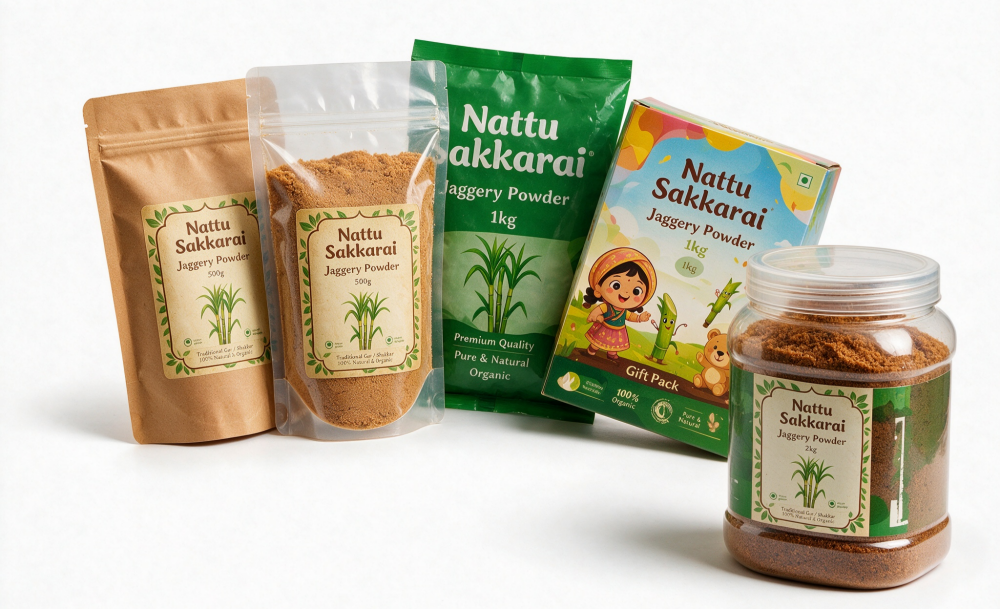
For international B2B buyers and food processing managers in the organic agriculture export sector, packaging Nattu Sakkarai represents a highly specialized challenge. Unlike refined white sugar, which is crystalline and free-flowing, traditional Nattu Sakkarai is unrefined jaggery powder. It is cohesive, highly hygroscopic (moisture-absorbent), sticky due to natural molasses content, and prone to severe clumping (bridging) under slight pressure.
Attempting to pack this material using standard volumetric cup fillers or gravity-fed systems designed for white sugar will inevitably lead to uneven filling weights, constant mechanical blockages in the hopper, and weak, leaking pouch seals.
Nattu Sakkarai Packing Machine
The structural behavior of Nattu Sakkarai requires a dedicated packaging design that manages product cohesion and ambient moisture.
                    [Organic Raw Bulk Jaggery Silo]
                                  │
                                  ▼
         [Closed-Loop Auger Hopper (Constant Low-Speed Agitation)]
                                  │
                                  ▼
      [Station 1: Volumetric Pre-Dosing via Dual-Flight Servo Auger]
                                  │
                                  ▼
      [Station 2: Dust Extraction & Pneumatic Bottom-Up Filling]
                                  │
                                  ▼
         [Dual-Cylinder Constant Pressure Sealing (ASTM F88)]
Because Nattu Sakkarai has high moisture and oil retention, the powder easily forms a solid "bridge" or "rat-hole" directly above the throat of the dosing screw. To prevent this, the hopper must feature an independently driven, slow-speed counter-rotating scraper blade. This blade continually shears the cohesive powder, maintaining a uniform bulk density in the lower hopper so that the auger flights fill completely and consistently.
During the vertical drop of jaggery powder into a pouch, fine, molasses-coated particles remain suspended in the air. When the hot sealing jaws clamp together, this trapped powder melts into a caramelized, tar-like residue on the jaw face. This residue quickly degrades the heat transfer profile, causing weak seals and micro-leaks.
To prevent this, the filling machine must include an integrated dust-extraction shroud at the nozzle tip, combined with a pouch-tapping (settling) device to knock airborne particles down to the bottom of the pouch before the sealing cycle begins.
| Packaging Parameter | Target Engineering Metric | Mechanical Mechanism | Relevant Industrial Standard |
| Volumetric Accuracy | $\pm0.3\%$ to $\pm0.5\%$ | Absolute encoder-controlled AC servo motor driving the auger shaft. | ISO 9001:2015 Quality Standards |
| Material Build | AISI 316L Stainless Steel | Highly polished contact surfaces ($Ra \le 0.4\,\mu\text{m}$) to prevent molasses adhesion. | FDA Sanitary & GMP Compliance |
| Seal Strength | $\ge 25\,\text{N}/15\text{mm}$ peel strength | Double-cylinder pneumatic or servo-actuated constant pressure sealing jaws. | ASTM F88 Tensile Seal Testing |
| Dust Protection | Closed-loop negative pressure | Built-in vacuum extraction shroud running at 200 CFM. | ATEX Zone 22 (Dust Hazard Protection) |
Jaggery powder is highly hygroscopic; it begins to absorb moisture from the surrounding air if the ambient relative humidity (RH) rises above 50% at $25^\circ\text{C}$. Once the powder absorbs moisture, the natural sugars dissolve slightly, making the product incredibly sticky and almost impossible to dose through a standard screw.
The entire filling section of the machine must be enclosed in a dehumidified acrylic or polycarbonate isolation chamber, or configured with a continuous dry nitrogen gas-flushing system inside the hopper. This keeps the internal humidity below 45% and ensures the powder remains dry and free-flowing throughout the packaging run.
Because molasses residues can build up over time, the dosing and filling assemblies require frequent deep cleanings. If operators must use heavy hand tools to remove the hopper and auger screw, changeover times will impact overall plant efficiency.
Always specify a split-hinged hopper design held together by sanitary tri-clamp connectors. This allows operators to swing the hopper open on hinges, pull out the auger screw without tools, wash down the contact surfaces, and dry them within 15 minutes.
The Plant Setting: An organic agricultural processing cooperative in Southern India packaging traditional unrefined Nattu Sakkarai into 500g and 1kg stand-up doypacks for export.
The Problem: The cooperative was using a standard volumetric cup filling machine. Due to humidity and density shifts, weight variations reached $\pm 18\text{g}$ per bag, resulting in substantial product giveaway. Additionally, caramelized sugar buildup on the constant-heat sealing jaws caused an 8.4% pouch rejection rate due to slow leaks during container shipping.
The Solution: The cooperative upgraded to a vertical form-fill-seal (VFFS) machine equipped with a servo-driven auger filler, an air-operated pinch-valve nozzle, a vertical bag-tapping device, and an inline checkweigher feedback loop. The sealing station was updated to use PTFE-coated impulse sealing jaws running on a closed-loop temperature control system.
The Result: Weight variation was reduced to a consistent $\pm 1.5\text{g}$, and the pouch leak rate dropped from 8.4% to under 0.1%. The cooperative cut product giveaway and film waste, saving an estimated $29,500 in operating costs within the first six months of installation.
When sourcing an automated packing line for Nattu Sakkarai, protect your operational margins by avoiding these common purchasing mistakes:
Pitfall 1: Relying on Gravity-Fed Vibratory Fillers
The Danger: Vibratory feeders rely on the product's ability to slide smoothly over a metal tray. Because Nattu Sakkarai is cohesive and sticky, it will clump on the vibratory tray, causing the flow to stall and creating massive weight variations. Always use a vertical forced-displacement auger screw to feed this material.
Pitfall 2: Overlooking the Need for a Split-Hopper
The Danger: A solid, single-piece hopper requires operators to reach down into the dosing screw to clean it. Sugar residue will eventually bake onto the auger shaft, leading to friction and motor overload. Insist on a fully-opening, split-hinge hopper for fast, visual sanitary inspections.
Pitfall 3: Using Cheap Constant-Heat Brass Sealing Jaws
The Danger: Traditional brass jaws maintain a high, constant heat that can easily scorch any sugar dust in the seal zone, creating black spots and weak seals. Insist on impulse sealing jaws with an integrated cooling phase, or use ultrasonic sealing jaws that vibrate stray sugar particles out of the seal zone before melting the film layers.
Engineer Answer: For sticky, non-free-flowing powders like Nattu Sakkarai, we recommend a variable-pitch auger screw where the top flights are spaced wider to draw bulk material down, and the bottom flights are tightly pitched to compress and meter the powder precisely. A straight, standard-pitch screw will pack the sticky powder too tightly at the exit, leading to jamming.
Engineer Answer: This is called "caking" and is caused by two factors: high initial moisture content in the powder (above 1.5% to 2.0%) or high moisture vapor transmission through the packaging film. To prevent this, ensure the powder is dried properly before packaging, and use high-barrier laminated packaging films—such as PET/ALU/PE or Kraft Paper/ALU/PE—to block moisture transmission.
Engineer Answer: Friction between the film web and the forming collar generates static electricity, which pulls fine sugar dust to the sealing area. To resolve this, install active ionizing air bars (static eliminators) directly upstream from the forming shoulder. These bars neutralize the static charge on the film web, allowing gravity to pull the powder straight down to the bottom of the bag without sticking to the sides.
Written by Helen Xu | Chief Industrial Application Engineer
Helen Xu is a Chief Industrial Application Engineer with 9 years of specialized experience in packaging machinery and liquid filling machine design, equipment model selection, and full production line process optimization. He focuses on delivering customized packaging & filling solutions for pharmaceutical, food, and chemical manufacturing industries, with mature practical expertise in GMP compliance, ISO 9001 quality management standards, and turnkey large-scale filling & packaging production line integration.
E-mail Us
Chat With Us


