
-
E-mail
-
WhatsApp & WeChat
WhatsApp & WeChat
 Blister Packaging Line
 Automatic Counting Machine Line
 Liquid Filling Machine Line
 Powder Filling Machine Line
 Granule Filling Machine Line
 Bag Packing Machine
+86 151 6187 8967
Medicine Blister Packing Machine
Blister quality problems are almost always a temperature, dwell or pressure window problem, or a material mismatch; the nameplate decides far less than buyers expect. A medicine blister packing machine bought on brand still hands you a window you have to find, prove and re-prove. I have spent more commissioning hours re-establishing a lost seal window on a two-year-old machine than repairing one. This piece follows the order I work on site: material, forming, sealing window, inspection, changeover, paperwork.
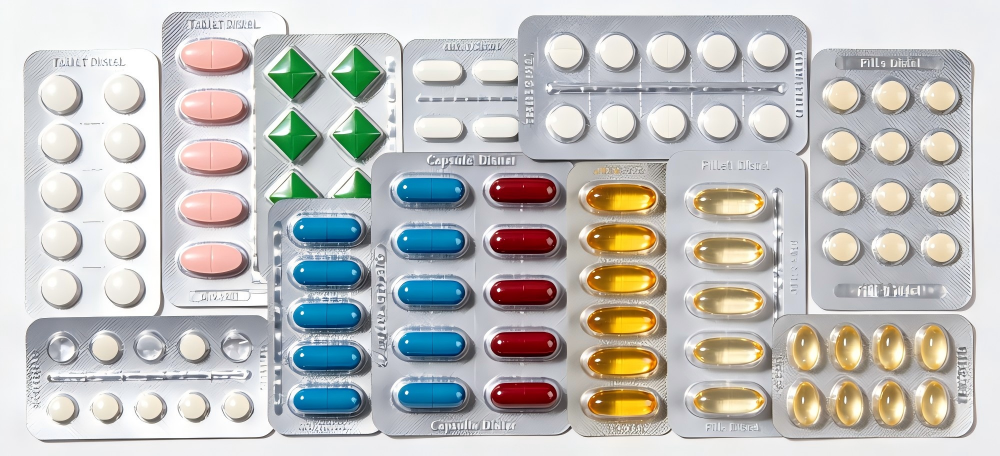
Medicine Blister Packing Machine
Put the material into the URS of any medicine blister packing machine before you argue about speed. Every decision starts with draw depth, because depth sets the forming method, the method sets the cycle time, and the cycle time decides how many machines you need. Thermoforming heats a PVC or PVC/PVDC/ACLAR web and pulls it into a cavity with plug assist plus compressed air. Cold forming presses an OPA/AL/PVC laminate into a die at room temperature; the aluminium work-hardens rather than softening.
| Attribute | Thermoforming (PVC / PVDC) | Cold forming (OPA 25 / AL 45 / PVC 60) |
|---|---|---|
| Draw depth | 8–14 mm standard; 18 mm with plug assist and thinned corners | 4–7 mm; pinhole risk climbs past 8 mm |
| Cycles/min at 250 mm index | 25–45 | 10–18 |
| Web cost per blister | US$0.008–0.013 PVC; US$0.018–0.030 at 60 g/m² PVDC | US$0.09–0.16 |
| Corner condition | 55–70 % of flat gauge | no melt thinning; foil thinning is the leak path |
| Light protection | none | total |
Two checks I now run at URS stage, because both have arrived at SAT on my projects. Cold-form cavities need roughly double the pitch for the same tablet, so a ten-cavity alu-alu blister is wider than a ten-cavity PVC one and may not fit the cartoner bucket you already own. And a machine sized for PVC will not hold its nameplate on cold form, since the sealing dwell roughly doubles. Budget a speed penalty near a third.
Transmission data is the only honest way to choose between laminates, and the test conditions matter as much as the figure. Values below are typical industry figures at 38 °C/90 % RH for water vapour. Oxygen is often quoted by film suppliers at 23 °C/50 % RH, so confirm the conditions before you compare two data sheets. Your supplier's certificate of analysis governs release, not this table.
| Material | WVTR g/m²·day | OTR cm³/m²·day | Where it stops making sense |
|---|---|---|---|
| PVC 250 µm | 2.5–3.5 | 20–40 | Dry product, temperate climate |
| PVC/PVDC 60 g/m² | 0.25–0.45 | 0.6–1.5 | Most EU and Southeast Asian solid dose |
| PVC/PVDC 120 g/m² | 0.10–0.20 | 0.3–0.8 | Hygroscopic tablets, Zone IVa |
| PVC/PE/ACLAR (PCTFE) | 0.04–0.10 | 0.2–0.6 | High barrier without aluminium, keeps speed |
| Cold-form OPA/AL/PVC | 0.00 (below detection) | 0.00 | Zone IVb, light-sensitive, effervescent |
Zone IVb in the ICH stability matrix is 30 °C/75 % RH, and it drives most Gulf and Southeast Asian distribution. Real warehouses exceed it; I have logged 43 °C inside a non-climatised Gulf store in summer.
Take a 3 cm² cavity on 250 µm PVC at 3.0 g/m²·day. It admits roughly 0.9 mg of water per day under test conditions. Compare that with the headroom between your tablet's initial water content and its specification limit, then derate for real warehouse temperature. That sum, ten minutes of your formulation group's time, usually eliminates plain PVC before anyone prices a machine.
Sealing is a heat-seal lacquer melting into a formed web under a calibrated jaw. Four variables interact, and moving one without the others is the most common commissioning fault I see.
Hard-tempered 20 µm aluminium (8011 or 8021) with 4–8 g/m² heat-seal lacquer is the standard push-through lid. Soft-tempered 25–30 µm aluminium or paper/PET laminates serve peelable lids, running cooler with a lacquer chosen for fibre-tear peel. A child-resistant peel-push lid adds a PET ply and moves the window again. Change lid supplier and you re-run the window; a few degrees of difference in lacquer melt onset has cost me two sealing trials.
| Defect | Most likely cause | First check |
|---|---|---|
| Channel leak at the corner | Dwell short, or pressure low for the lacquer | Raise pressure 0.5 bar before touching temperature |
| Blushing (white haze) | Temperature high, lacquer over-melted | Drop 8–10 °C, then check plate flatness |
| Lidding wrinkle | Jaw closing on a moving web, or plate out of parallel | Parallelism at four corners, unwind tension |
| Print to cavity misregistration | Index drift or uncompensated web stretch | Encoder coupling, print repeat compensation |
| Pocket bridging | Feeder over-fill or deduster bypassed | Fill level in the magazine, not the camera |
| Cut burr on the edge | Blunt die or wrong die clearance | Inspect the die at two million cycles, not twelve |
Cameras do four jobs: presence/absence, broken or chipped tablet, colour and print verification, cavity-level rejection. Sensitivity can be wrong in either direction, and only one direction gets budgeted.
On a 240 blisters/min line with ten-cavity blisters, tightening the grey-level tolerance on a broken-tablet check from 12 to 6 levels moved detection from 98.7 % to 99.4 % and false rejects from 0.35 % to 3.1 %. At 2,400 cavities per minute that is about 74 good cavities rejected every minute, near 35,000 a shift to account for. We settled at 9 levels with a second camera angle: detection 99.2 %, false rejects 0.6 %. A false reject is not scrap, it is good product destroyed plus reconciliation paperwork.
A full format change means a forming die set, sealing plate and knurl, feed magazine or brush box, guide rails, perforation and cutting die, print file or cylinder, and a camera teach. Two technicians take 90–150 minutes. A change inside the same tooling family, same cavity layout with a different tablet, is 25–45 minutes. Both are measured on plant floors; brochures quote the second as though it were the first.
For a CMO running thirty formats a year the multiplier is the argument. Thirty times two hours is sixty hours of capacity, which at 240 blisters/min approaches 860,000 blisters. That is why a medicine blister packing machine for a CMO should be judged on feeder and magazine flexibility rather than peak speed. Ask how many brush boxes and magazine inserts ship with the machine, how long a spare set takes to arrive, and whether one insert handles a capsule and a round tablet.
A Gulf-coast plant packing a hygroscopic film-coated tablet for domestic and Southeast Asian distribution ran PVC/PVDC 60 g/m² on an eight-year-old flat-plate machine rated 300 blisters/min, on 220–240 V/50 Hz. The hall reached 42 °C in summer and the site cooling loop sat at 31 °C, so plate temperature drifted across the shift.
Before: dye-ingress testing on 200-pocket samples failed at 4.8 % of pockets, nearly all at the corner, and the line ran 190 blisters/min because operators had slowed it to keep the seal alive. We added a dedicated chilled-water circuit at 18 °C on the sealing plate, moved the setpoint from 178 °C to 196 °C with measured spread of ±2.5 °C, took dwell from 0.45 s to 0.70 s and pressure from 3.2 bar to 4.6 bar, and fitted new knurl plates (the old ones had eleven million cycles). Across three consecutive batches: dye-ingress failures 0.2 %, vacuum-decay rejects 0.4 %, sustained speed back to 260 blisters/min. Nine days including the OQ re-run, under a third of a new machine. The window had been lost, not the machine.
An EU GMP site expects the sealing process qualified, and qualification means a documented parameter window, not a setpoint: a low, target and high value for temperature, dwell and pressure, with product sealed at the window edges and leak-tested, so the window is proven rather than assumed. That sits under qualification and validation, delivered as IQ, OQ and PQ protocols in English. Confirm which GMP chapter and annex your QA group audits against before writing the protocol list.
ISO 15378 governs primary packaging materials, so it applies to your film and foil supplier; hold their certificate with incoming inspection records. ISO 9001 covers the equipment maker's quality system, and ISO 13485 is the right ask if the machine will ever run a device or combination product. For the machine, CE conformity in the EU now falls under Machinery Regulation (EU) 2023/1230, while Great Britain asks for UKCA. Gulf and Southeast Asian authorities have no single equivalent mark, so the English documentation package plus IQ/OQ/PQ is what the local inspector reads.
One purchase-order line saves arguments: validation documents, electrical drawings, spare-parts list and a full software backup, in English and editable, released before final payment.
Can one machine run both PVC and cold-form alu-alu?
Mechanically yes, with a different forming station and sealing philosophy. Budget a speed penalty near 30–40 % on cold form and a separate window validation per material. Do not let a quotation imply one is free.
Which leak test belongs in the specification?
Dye ingress for a visual pass/fail screen on a sample, plus a deterministic method such as vacuum decay where you need a trendable number. Add peel strength at the knurl as a cheap third indicator. Agree limits with QA before FAT.
How do we know the window is still valid in year three?
Log plate temperature and jaw pressure per batch and re-challenge the window edges at periodic review. A leak rate creeping up over three months usually means a worn knurl or a heater cartridge losing output.
Is cold form mandatory for Gulf markets?
Not automatically. It depends on moisture and light sensitivity and on your stability data. High-barrier PVC/PVDC or an ACLAR laminate is often enough and runs several times faster. Confirm the expectation with your regulatory affairs team.
Which utilities get forgotten in hot regions?
Chilled water for the sealing plate, a compressed-air reserve of 200–400 Nl/min at the forming station that still holds in a heatwave, and the electrical spec. EU 400 V/50 Hz and Gulf or SEA 220–240 V/50 Hz are both simple if stated up front; a 220 V/60 Hz site needs motors and drives written into the order.
How many spare change-part sets should we buy?
One full set per format family for a two-shift plant, plus a second set of anything with a lead time beyond eight weeks. Knurl plates are wear items. Buy two.
Written by Helen Xu | Chief Industrial Application Engineer
Helen Xu is a Chief Industrial Application Engineer with 9 years of specialized experience in packaging machinery and liquid filling machine design, equipment model selection, and full production line process optimization. He focuses on delivering customized packaging & filling solutions for pharmaceutical, food, and chemical manufacturing industries, with mature practical expertise in GMP compliance, ISO 9001 quality management standards, and turnkey large-scale filling & packaging production line integration.
E-mail Us
Chat With Us


