
-
E-mail
-
WhatsApp & WeChat
WhatsApp & WeChat
 Blister Packaging Line
 Automatic Counting Machine Line
 Liquid Filling Machine Line
 Powder Filling Machine Line
 Granule Filling Machine Line
 Bag Packing Machine
+86 151 6187 8967
Masala Powder Packing Machine
A masala powder packing machine fails on three fronts at once — the hard particles wear the auger, the volatile oils escape through a poor seal, and the mycotoxin rules decide your paperwork. I have run a garam masala line in Chennai where an untreated 304 auger lost 0.4 mm of flight in 900 hours and residual oxygen sat at 2.8%; nitriding the flight and adding a nitrogen flush took wear to 0.05 mm and O2 to 0.7%. If the quotation covers speed and ignores the triple constraint, it is specifying the wrong machine.
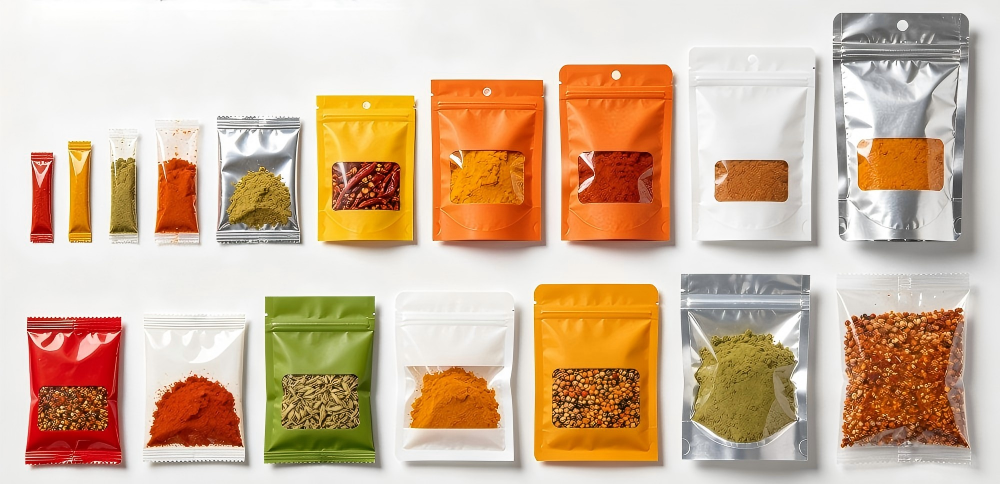
Masala Powder Packing Machine
Masala is three problems in one product. It is abrasive — dried chilli, turmeric, and clove particles are harder than mild steel and grind the auger flight. It is aromatic — volatile oils (eugenol, curcuminoids, capsaicinoids) oxidise and escape when residual oxygen is high, so the pack smells flat within weeks. And it is regulated — aflatoxin B1 limits are set in law, and the packing line is part of the control chain. A machine specified on speed alone fails on all three.
| Constraint | Failure mode | What controls it |
|---|---|---|
| Abrasion | Flight wear → dose drift | Hardened / ceramic auger, WLR |
| Aroma | Oil oxidation, flat smell | Nitrogen flush, low O2, barrier film |
| Aflatoxin | Non-compliant lot | Tested raw, no cross-contamination, traceability |
A 304 auger running chilli powder loses flight material to abrasive wear; on a high-throughput line that is 0.3–0.5 mm per 1,000 hours, enough to shift dose by 1–2%. Nitriding the flight raises surface hardness and cuts wear to 0.05 mm per 1,000 hours. For the hardest blends (clove, dried ginger), a ceramic-coated or tungsten-carbide flight is the only option that holds tolerance. The cost is 10–25% on the auger; the alternative is re-qualification every quarter.
| Auger surface | Wear per 1,000 h (chilli blend) | Dose drift at 1,000 h |
|---|---|---|
| 304 stainless | 0.4 mm | 1.5–2.0% |
| Nitrided | 0.05 mm | < 0.3% |
| Ceramic-coated | 0.02 mm | < 0.2% |
Volatile oil loss is an oxidation problem, governed by residual oxygen in the headspace. A passive seal at 2.8% O2 loses pungency in weeks; a nitrogen flush pulling headspace to 0.7% holds it for the shelf life. The flush is not a luxury for premium masala — it is the difference between a product that smells like the sample and one that does not. Measure O2 in the headspace, not the mixer.
Aflatoxin B1 limits are binding: EU Regulation 2023/915 sets 5 µg/kg for ground spices, 10 µg/kg for whole; US FDA action levels are in the same band; the Gulf and SEA set their own but align closely. The packing machine cannot remove aflatoxin, but it must not cross-contaminate between lots and must carry traceability so a bad lot is isolatable. Specify cleanable contact surfaces and lot-tracked operation.
The plant ran a 50 g garam masala into a laminate sachet at 55 sachets/min, product d50 110 µm with 8% oil content, in a 33 ± 4 °C, 64% RH room. Original auger was 304; headspace was passive at 2.8% O2.
Complaints were dual: dose drift of 1.8% by month six (flight wear), and "lost aroma" returns from humid-south distributors. We replaced the auger with a nitrided flight, added a nitrogen flush at the fill throat pulling headspace to 0.7%, and moved to a metallised barrier film. Flight wear dropped to 0.05 mm per 1,000 h; dose drift to 0.3%; aroma hold extended past the 9-month shelf life. Speed held at 55/min.
| Parameter | Before | After |
|---|---|---|
| Auger wear (per 1,000 h) | 0.4 mm | 0.05 mm |
| Dose drift | 1.8% | 0.3% |
| Residual O2 | 2.8% | 0.7% |
| Aroma hold | Weeks | > 9 months |
Aflatoxin limits under Regulation (EU) 2023/915; food contact under EU 10/2011; CE marking. Imported ground spices face border testing, so documentation must travel with the lot.
FDA aflatoxin action levels and 21 CFR 110 (cGMP); FSMA preventive controls apply. Traceability is expected under the FSMA traceability rule for certain foods.
India (FSSAI) sets its own aflatoxin and labelling rules; halal covers the Muslim market in Indonesia and Malaysia. High ambient humidity makes aroma loss and caking the local failure modes.
Saudi SFDA and GCC set aflatoxin limits and halal (SASO/GSO) is mandatory. Heat accelerates oil oxidation, so flush and barrier are non-negotiable.
Abrasion. A 304 auger loses 0.4 mm per 1,000 h on chilli and drifts 1.5–2%. Nitrided or ceramic holds it under 0.3%. On the Chennai case, that change fixed a 1.8% drift.
Nitrogen flush to 0.7% headspace O2 with a barrier film. At 2.8% passive, pungency is gone in weeks. Measure O2 in the sachet, not the mixer.
No machine removes it, but it must not cross-contaminate and must carry lot traceability so a bad lot is isolatable. That is your compliance floor.
For the Muslim markets (Gulf, Indonesia, Malaysia), yes — halal covers the line cleaning agents and any added carrier, not just the spice. Confirm SASO/GSO scope.
Written by Helen Xu | Chief Industrial Application Engineer
Helen Xu is a Chief Industrial Application Engineer with 9 years of specialized experience in packaging machinery and liquid filling machine design, equipment model selection, and full production line process optimization. He focuses on delivering customized packaging & filling solutions for pharmaceutical, food, and chemical manufacturing industries, with mature practical expertise in GMP compliance, ISO 9001 quality management standards, and turnkey large-scale filling & packaging production line integration.
E-mail Us
Chat With Us


