
-
E-mail
-
WhatsApp & WeChat
WhatsApp & WeChat
 Blister Packaging Line
 Automatic Counting Machine Line
 Liquid Filling Machine Line
 Powder Filling Machine Line
 Granule Filling Machine Line
 Bag Packing Machine
+86 151 6187 8967
Masala Pouch Packing Machine
A masala pouch packing machine in a humid market fails by caking, not by speed. Turmeric and chilli powder pull moisture from air above 60% RH and form lumps that bridge the auger and block the spout. I ran a 200 g turmeric stand-up pouch line in Dhaka where caking reject was 4% in the monsoon; a dehumidified feed and a degassing valve took it to 0.3%. If the quotation leads with pouches per minute and ignores humidity, it is specifying for a desert.
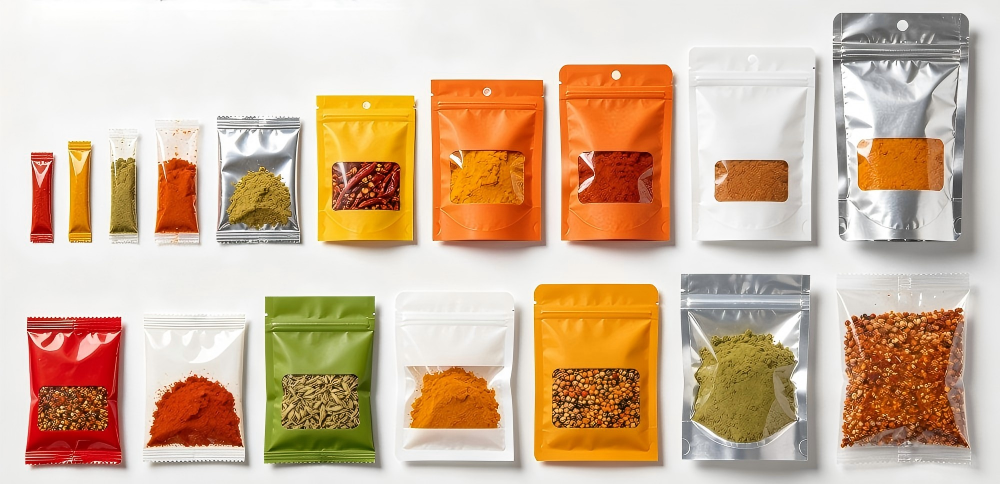
Masala Pouch Packing Machine
Masala powders are hygroscopic. Turmeric holds 8–10% moisture at 65% RH and climbs fast above that; chilli and garam blends behave similarly. The moisture does two things: it makes the powder stick to the auger and hopper wall, and it forms inter-particle bridges that become lumps. Above 60% RH, a standard feed cakes within a shift; the lumps block the auger and the spout, and the reject rate climbs. The cause is the room, not the machine — so the fix is environmental control at the feed, not a faster filler.
| Room RH | Turmeric moisture gain | Caking reject (standard feed) |
|---|---|---|
| 45% | Baseline | < 0.5% |
| 60% | + 1.5% | 1–2% |
| 75% (monsoon) | + 3.5% | 3–5% |
| 85% | + 5% | > 6% |
For retail masala, the stand-up doypack with a zip wins on shelf and in the basket, but it demands a clean fill throat and a settled product. The pouch is formed or pre-made; pre-made pouches give better control on a humid floor because the film is not exposed to the room during forming. The zip must be blown open and the pouch inflated before fill, or the product lands on the zip and the seal fails. That inflation step is where humid lines lose pouches if the air is not dry.
A degassing valve releases the air displaced during fill and any residual moisture vapour, protecting the seal and the product. The film must carry a moisture barrier — a metallised or EVOH layer — because the pouch sits in a humid shop. A plain OPP pouch transmits moisture and the masala cakes inside the pack on the shelf. The valve and the barrier are a pair; one without the other fails.
The plant ran a 200 g turmeric stand-up pouch at 45 pouches/min, pre-made doypack with zip, in a 31 ± 3 °C, 78% RH monsoon room. Original feed was an open hopper with a standard auger; caking reject ran 4%, and lumps blocked the spout on one in 25 fills.
We added a dehumidified feed enclosure holding the hopper at 50% RH, a gentle agitator to stop bridging, a dry-air pouch inflation at the zip, and a metallised barrier film with a degassing valve. Caking reject fell to 0.3%; spout block to 0.1%. Speed held at 45/min. The filler speed never changed — the environment did.
| Parameter | Before | After |
|---|---|---|
| Caking reject | 4% | 0.3% |
| Spout block | 4% | 0.1% |
| Hopper RH | 78% | 50% |
| Film / valve | Plain OPP | Metallised + degassing valve |
Food contact under EU 10/2011; CE marking. A metallised barrier with a valve must declare migration. Average quantity rules apply to the dose.
FDA 21 CFR 110 for food contact; NIST Handbook 133 for net quantity. Zip and child-resistant features add validation for certain products.
Bangladesh, India (FSSAI) set food and labelling rules; halal covers the Muslim market in Indonesia and Malaysia. Humidity is the dominant local failure mode — caking and seal integrity both track it.
Saudi SFDA and GCC anchor conformity; halal (SASO/GSO) mandatory. Heat plus humidity in coastal Gulf cities makes the barrier and valve non-negotiable.
Humidity. Above 60% RH the powder pulls moisture and bridges. A dehumidified feed at 50% RH and a barrier film with a valve took the Dhaka line from 4% caking to 0.3%. The filler speed was never the problem.
In a humid room, yes — pre-made pouches avoid exposing film to the room during forming. Form-fill-seal exposes the web to monsoon air and cakes faster.
For humid storage and shelf life, yes. It releases displaced air and vapour so the seal holds and the product stays free-flowing. A barrier film without the valve still stresses the seam.
Dry enough that it does not add moisture at the zip — use a desiccant or refrigerated dryer on the inflation line in monsoon rooms. Wet inflation is a hidden caking source.
Written by Helen Xu | Chief Industrial Application Engineer
Helen Xu is a Chief Industrial Application Engineer with 9 years of specialized experience in packaging machinery and liquid filling machine design, equipment model selection, and full production line process optimization. He focuses on delivering customized packaging & filling solutions for pharmaceutical, food, and chemical manufacturing industries, with mature practical expertise in GMP compliance, ISO 9001 quality management standards, and turnkey large-scale filling & packaging production line integration.
E-mail Us
Chat With Us


