
-
E-mail
-
WhatsApp & WeChat
WhatsApp & WeChat
 Blister Packaging Line
 Automatic Counting Machine Line
 Liquid Filling Machine Line
 Powder Filling Machine Line
 Granule Filling Machine Line
 Bag Packing Machine
+86 151 6187 8967
Honey Packaging Machine
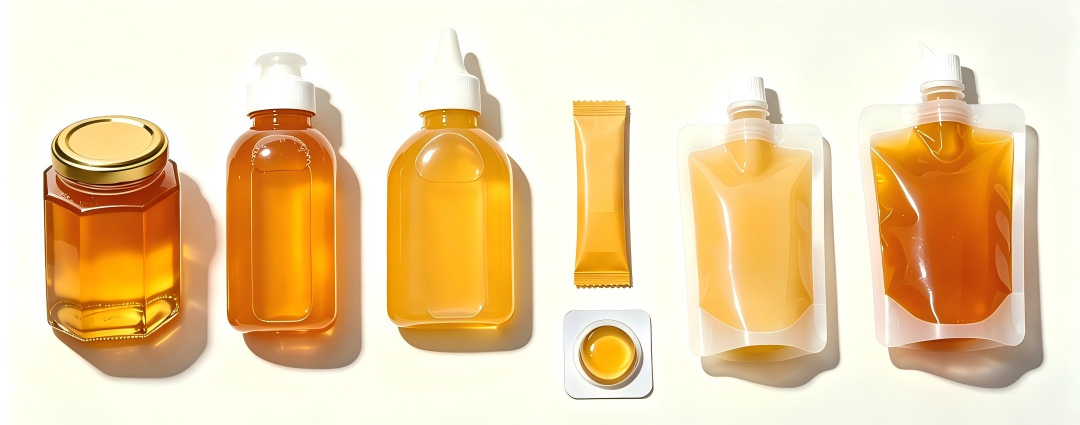
Honey Packaging Machine
To achieve clean, drip-free portioning and maintain a filling accuracy within $\pm0.5\%$, an industrial honey packaging machine must utilize positive-displacement volumetric piston pumps or high-precision rotary lobe pumps equipped with temperature-controlled heating jackets and pneumatic anti-drip cut-off nozzles.
For production engineers and procurement managers in the food processing and apiculture sectors, configuring a honey packaging line introduces unique rheological challenges. Honey is a highly viscous, non-Newtonian, thixotropic fluid whose physical behavior changes drastically with temperature.
If a packaging plant attempts to fill honey using standard gravity or low-pressure overflow fillers designed for water or oils, they will encounter severe volumetric inaccuracies caused by air pockets, persistent stringing that ruins film seals, and product crystallization inside the piping.
Honey packaging systems are mechanically divided based on the dosing mechanism. Choosing between a pneumatic/servo piston system and a rotary lobe system dictates the line’s long-term operational flexibility and target container types.
                  [Raw Bulk Honey Storage Tank]
                                │
                                ▼
         [Double-Jacketed Heated Hopper (Constant 35°C–40°C)]
                                │
                                ▼
       ┌────────────────────────┴────────────────────────┐
       ▼                                                 ▼
[Volumetric Piston System]                     [Rotary Lobe Pump System]
  • Best for: Small Sachets/Sticks               • Best for: Bulk Jars/Tubs
  • Mechanism: Linear Stroke Displacement        • Mechanism: Continuous Rotation Metering
       │                                                 │
       └────────────────────────┬────────────────────────┘
                                ▼
             [Pneumatic Anti-Drip Cut-Off Nozzle]
                                │
                                ▼
              [Clean Container / Pouch Thermal Seal]
This system relies on a high-precision cylinder and piston assembly. On the intake stroke, the piston draws a fixed volume of honey from the hopper into the cylinder. On the discharge stroke, a three-way rotary valve switches, and the piston forces the exact fluid volume through the nozzle. This positive mechanical displacement easily overcomes honey's natural resistance to flow, ensuring consistent volumes regardless of shifts in product density.
For continuous, high-volume lines, a servo-driven rotary lobe pump is preferred. The interlocking lobes transport honey along the interior perimeter of the pump casing without compressing or shearing the product. By tracking the exact angular rotation of the lobes via an absolute encoder, the system delivers high-speed, continuous dosing that easily integrates with inline checkweighers.
| Engineering Parameter | Industrial Target Metric | Mechanical Implementation Strategy | Relevant Global Standard |
| Volumetric Accuracy | $\pm0.3\%$ to $\pm0.5\%$ | Servo-driven linear actuators regulating piston stroke displacement. | ISO 9001:2015 Quality Controls |
| Temperature Regulation | $35^\circ\text{C}$ to $40^\circ\text{C}$ ($\pm1.0^\circ\text{C}$) | Water-jacketed hoppers and heat-traced delivery lines with PID loop control. | HACCP Food Safety Guidelines |
| Drip and Stringing Control | Zero tailing / clean cut-off | Pneumatic blow-back nozzles or mechanical reverse-suction piston strokes. | FDA 21 CFR Food Packaging |
| Sanitation Compliance | Full Clean-in-Place (CIP) | Seamless 316L stainless steel, internal radii $\ge3\text{mm}$, quick-clamp fittings. | EHEDG Doc 2 / FDA GMP |
Because honey has high cohesive strength, it naturally forms a long, sticky thread or "tail" when a filling cycle terminates. If this tail falls onto the rim of a glass jar or the sealing area of a flexible laminate pouch, it fouls the capping or thermal sealing station, causing structural seal failure and product leakage.
To prevent this, honey packaging machines must use specialized pneumatic cut-off nozzles. These nozzles feature an internal plunger that seals the opening flush at the exact millisecond the filling stroke ends. Advanced systems incorporate a reverse-suction (suck-back) piston stroke that pulls a tiny amount of product back into the nozzle tip, ensuring a clean cut-off.
[Filling Phase]                  [Termination Phase]              [Suck-Back Phase]
 ──│       │──                    ──│       │──                    ──│       │──
   │   │   │                        │   ▼   │                        │   ▲   │
   │   ▼   │                        │   █   │                        │   ▲   │
 ──└──   ──┘──                    ──└───█───┘──                    ──└───█───┘──
   (Honey Flows)                   (Plunger Closes)                 (Residual Pulled Up)
At room temperature ($20^\circ\text{C}$), pure honey can exhibit a viscosity anywhere from 10,000 to over 20,000 centipoise (cP). If the temperature drops, viscosity spikes exponentially, causing pump cavitation, air binding, and severe strain on mechanical drives.
The machine hopper and product transfer tubes must be equipped with a constant-temperature water jacket. Heating the honey to a precise range of $35^\circ\text{C}$ to $40^\circ\text{C}$ drops its viscosity to a manageable 2,000–3,000 cP, enabling high-speed packaging without overheating or degrading the raw honey’s delicate enzymes and HMF (Hydroxymethylfurfural) thresholds.
The Plant Setting: A contract food packer running a 4-lane vertical stick pack machine for 15g single-serve honey portions.
The Problem: The line suffered a 6.4% reject rate because stringing honey regularly contaminated the horizontal heat-sealing jaws. The caramelization of burnt honey on the sealing jaws required the line to be shut down for 30 minutes every two hours for manual cleaning.
The Solution: The plant replaced the standard pneumatic slide valves with a custom servo-driven multi-lane piston filler featuring independent pneumatic blow-back nozzles. The thermal configuration was upgraded to a dual-jacketed hopper running a continuous hot water loop at $38^\circ\text{C}$.
The Result: The clean cut-off mechanism eliminated honey stringing entirely, dropping the packaging reject rate to under 0.18%. The facility reclaimed 2 hours of production time per shift, increasing daily output by 28%.
The Plant Setting: A commercial honey processing facility packing raw organic honey into 250g and 500g glass hex jars.
The Problem: The facility used a gear-pump timer filler that suffered from volumetric drift as the honey level inside the main storage tank fluctuated. This resulted in average overfills of 6.2g per jar to ensure legal label weights, representing substantial product giveaway. Additionally, the threaded pipe fittings were difficult to clean, raising sanitation concerns during batch changes.
The Solution: Engineers installed an automated rotary index filling and capping machine utilizing volumetric piston pumps driven by absolute servo motors. All product delivery lines were converted to sanitary DIN 11851 tri-clamp connections matching 316L stainless steel standards.
The Result: Filling precision tightened to $\pm0.8\text{g}$, saving the facility over 4.5 metric tons of honey annually. The line achieved full ISO 22000 food safety certification due to the tool-less, easy-clean assembly.
When sourcing a honey packaging system, protect your operational efficiency by avoiding these common specification errors:
Refusing to Specify 316L Stainless Steel: Honey is naturally acidic, with a pH ranging from 3.4 to 6.1. Under prolonged contact at elevated temperatures, this acidity can corrode lower-grade 304 stainless steel, resulting in trace metal contamination. Insist on 316L stainless steel for all components that make direct contact with the product.
Neglecting the Rotary Valve Geometry: Standard rotary valves designed for thin liquids can easily shear or bind when dealing with thick, unheated honey. Ensure your vendor provides a large-port rotary valve that allows high-viscosity fluids to pass through smoothly without creating structural friction or vacuum pockets.
Overlooking Hopper Agitation Requirements: Heated honey can experience temperature stratification, where the product near the jacket walls is warm but the center remains cold and dense. Ensure the machine hopper includes a low-speed horizontal sweeping agitator to evenly distribute heat throughout the batch.
Engineer Answer: Yes, but the machine configuration must change between runs. Clear honey flows well when heated to $38^\circ\text{C}$ and works perfectly with standard piston filler clearances. Creamed honey is a highly viscous paste that must be packed at lower temperatures ($18^\circ\text{C}$ to $22^\circ\text{C}$) to protect its crystal structure. Packing creamed honey requires changing to a heavy-duty auger-assisted hopper feed or a positive-displacement rotary lobe pump to push the dense paste into the piston chamber without causing cavitation.
Engineer Answer: If your product line demands extreme speeds, ultrasonic sealing is a major upgrade. Traditional heat sealing jaws must melt their way through any residual honey contamination to fuse the film layers. Ultrasonic sealing jaws use high-frequency acoustic vibrations to generate localized molecular heat directly within the plastic film. This vibration physically displaces any micro-droplets of honey out of the seal zone, creating an airtight bond even through a contaminated surface.
Engineer Answer: Because honey is highly water-soluble, it does not require aggressive chemical solvents. It is best cleaned using a hot water flush ($60^\circ\text{C}$ to $70^\circ\text{C}$) through the automated CIP cycle. However, ensure that the machine's pneumatic valves, servo encoders, and HMI housings carry a minimum rating of IP66 (or IP69K for direct washdowns) to prevent moisture from penetrating the electrical enclosures during sanitization.
Written by Helen Xu | Chief Industrial Application Engineer
Helen Xu is a Chief Industrial Application Engineer with 9 years of specialized experience in packaging machinery and liquid filling machine design, equipment model selection, and full production line process optimization. He focuses on delivering customized packaging & filling solutions for pharmaceutical, food, and chemical manufacturing industries, with mature practical expertise in GMP compliance, ISO 9001 quality management standards, and turnkey large-scale filling & packaging production line integration.
E-mail Us
Chat With Us


