
-
E-mail
-
WhatsApp & WeChat
WhatsApp & WeChat
 Blister Packaging Line
 Automatic Counting Machine Line
 Liquid Filling Machine Line
 Powder Filling Machine Line
 Granule Filling Machine Line
 Bag Packing Machine
+86 151 6187 8967
Ghee Packing Machine
The long-term operating profit of an industrial ghee packing machine depends on its temperature-controlled dosing circuit and oil-resistant impulse sealing precision, rather than its maximum nominal cycle rate. In commercial dairy processing plants, a slight temperature drop below ghee's melting threshold (32℃ to 35℃) during filling causes fat crystallization inside the dosing valves. This leads to an average 2.5% volume inaccuracy and greasy film seam contamination that pushes pouch leakage rates past 4.8%. For overseas B2B buyers, evaluating ghee packaging machinery requires looking beyond surface-level mechanical speed and analyzing the closed-loop thermal and volumetric systems that manage liquid fat dynamics under continuous plant conditions.
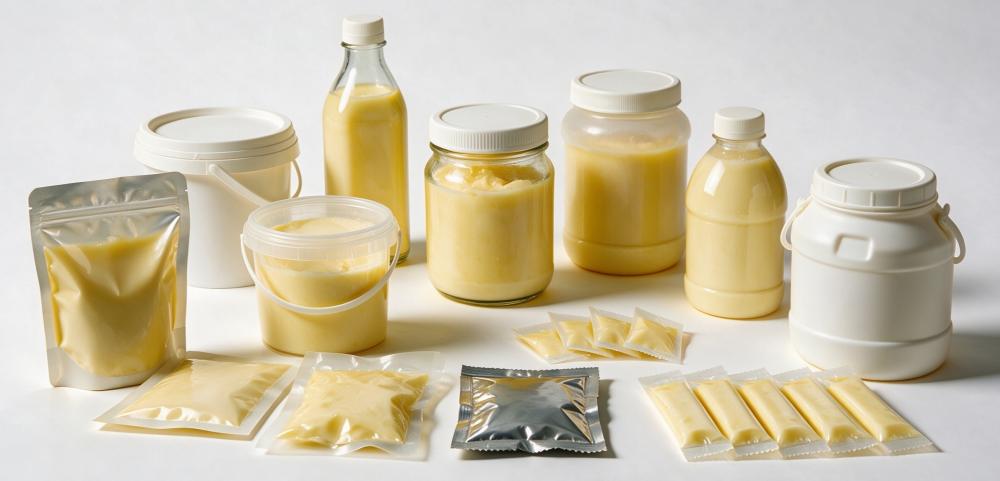
Ghee Packing Machine
Ghee (clarified butter oil) presents unique rheological properties that transition dynamically between a free-flowing liquid state at elevated temperatures (40 ℃ to 50 ℃) and a viscous, semi-solid granular state as it cools below 28 ℃.
When ghee cools within static machine piping during mid-shift pauses, higher-melting-point triglycerides solidify along the valve walls. Standard peristaltic or unheated gear pumps experience severe flow resistance when restarting. This pressure spike causes non-linear displacement, leading to under-filled packages or blown internal line gaskets.
Because ghee has a low surface tension, micro-droplets easily splash or creep onto the inner walls of flexible film pouches or rigid container necks during high-speed dosing.
[Unheated Filling Nozzle] -> [Ghee Splash on Seal Area] -> [Lipid Barrier Prevents Polymer Fusion] -> [Micro-Leakers During Transit]
During thermal jaw clamping, this trapped lipid layer prevents full polymer chain entanglement between the film's inner PE layers. As a result, pouches pass initial visual checks but fail under secondary stacking loads during logistics distribution.
Selecting the proper dosing architecture depends on whether your process fills ghee in a warm liquid state or a cooled, semi-solid "granular" state.
                    [Ghee Processing Temperature Profile]
                                      |
         -----------------------------------------------------------
        |                                                           |
[Warm Liquid State: 40°C - 50°C]            [Semi-Solid Granular State: 22°C - 28°C]
        |                                                           |
(Servo-Driven Piston / Gear Pump)              (Positive Displacement Lobe Pump)
        |                                                           |
  Best for: High-speed pouch VFFS,             Best for: Rigid jars/tins, preserving
  glass bottle filling, maximum speed          traditional granular texture (Danedar)
| Dosing Technology | Mechanical Mechanism | Target Packaging Format | Volumetric Accuracy | Primary Operational Constraint |
| Servo-Driven Heated Piston Filler | Positive displacement cylinder with double-jacketed hot water heating circuit | Flexible pouches (Pillow/Stand-up), bottles, rigid cans | ±0.2% to ±0.5% | Requires continuous hot water circulation to prevent valve seizing during idle periods. |
| Pneumatic Liquid Valve VFFS | Gravity or low-pressure feed with positive-cut anti-drip nozzle shut-off | High-speed pillow pouches (200ml to 1000ml PE film) | ±0.5% to ±1.0% | Sensitive to upstream surge-tank head pressure fluctuations. |
| Rotary Lobe Pump Filler | Low-shear intermeshing rotors with servo-encoder feedback | Wide-mouth jars, buckets, tin containers | ±0.3% to ±0.8% | Higher initial capital cost; requires high-precision mechanical seal maintenance. |
Ghee processing line procurement must comply with international sanitary engineering standards to prevent lipid oxidation, bacterial colonization, and transport degradation.
3-A Sanitary Standards & EHEDG: All product-contact piping, valve blocks, and dosing cylinders must conform to 3-A Sanitary Standards for dairy equipment. Surfaces must be fabricated from AISI 316L stainless steel with an internal mechanical polish of Ra < 0.4 μm to eliminate microscopic voids where fatty acids can collect and rancidify.
ISO 9001 & CE Compliance: Electrical cabinets must hold an IP66 ingress protection rating to allow direct low-pressure sanitary washdowns with chemical degreasers. Safety interlocks on rotating film belts and pneumatic jaw assemblies must comply with CE Machinery Directive 2006/42/EC.
ASTM F88 & ASTM F2096 Integrity Metrics: Pouches discharged from a high-speed ghee line must achieve a minimum seal strength of 35N/15mm under ASTM F88 peel testing to withstand internal hydraulic shock loads when cartons are dropped during maritime transport.
A major Middle Eastern dairy cooperative was running a dual-track vertical form-fill-seal (VFFS) line processing 1-liter PE-laminated ghee pouches at 70 packs per minute.
Unheated dosing nozzles caused ghee to drip onto the horizontal cross-seal zone, resulting in a 5.2% pouch rejection rate due to oily seal failures.
Ambient room temperature variations caused the ghee's density to shift between morning and afternoon shifts, driving weight variance to ±6.8g per 1,000g fill.
Uncontrolled film tension caused stretching in the thin multi-layer co-extruded film, leading to misaligned registration marks and uneven bag lengths.
[Unheated Nozzle Drip]  ---> Oil on Sealing Zone ---> Weak Polymer Fusion ---> 5.2% Leakage Rate
[Temperature Shifts]    ---> Viscosity Variations---> Density Drift       ---> ±6.8g Weight Drift
[Uncontrolled Tension]  ---> Film Stretching     ---> Photocell Misalignment ---> High Scrap Rate
Thermally Jacketed Dosing Circuit: Retrofitted a double-jacketed 316L stainless steel manifold heated by a closed-loop 45℃ water recirculation unit. Integrated a pneumatic positive-cut suck-back nozzle that draws remaining oil droplets upward at the instant the dosing stroke terminates.
Dynamic Mass Checkweigher Integration: Installed an inline high-speed checkweigher downstream linked via Ethernet/IP to the main servo drive PLC. The system automatically adjusted the piston stroke length in real time whenever it detected a 3-pack moving average weight drift exceeding ±0.8g.
Impulse Sealing & Constant-Tension Control: Replaced constant-heat sealing jaws with water-cooled impulse sealing bars fitted with double PTFE-coated glass cloth tape. Replaced mechanical friction brakes with a closed-loop servo-driven film feed roll featuring dancer-arm feedback.
[Jacketed Manifold + Suck-Back] ---> Eliminates Dripping    ---> Pristine Seal Zone   ---> < 0.08% Leakage
[Inline Checkweigher Feedback]  ---> Real-Time Adjustment   ---> Corrects Density     ---> ±0.4g Accuracy
[Impulse Jaws + Servo Tension]  ---> Cools Under Pressure   ---> Perfect Film Optics  ---> Zero Film Stretch
After 120 days of continuous multi-shift production, operational logs confirmed that the pouch leak rate dropped from 5.2% to under 0.08%. Dosing accuracy stabilized at ±0.4g per 1-liter pack, saving the processing facility approximately 1.8 metric tons of ghee product giveaway per month.
A: Granule formation in ghee depends on the slow, unagitated crystallization of palmitic and stearic fatty acids between 22 ℃ and 25 ℃. If a packaging line uses high-speed, high-shear pumps (such as centrifugal pumps) or forces warm ghee through tight nozzle orifices at extreme pressure, the fat crystal nuclei shatter. To retain the granular texture, fill the ghee at 42 ℃ to 45 ℃ using low-shear servo piston pumps, then route the sealed containers through a controlled static cooling tunnel maintained at 20 ℃ for 12 to 18 hours.
A: Virgin or co-extruded LDPE/LLDPE pouch films have a narrow thermal processing window. Constant-heat sealing jaws transfer heat continuously, causing localized film melt-through when the machine pauses briefly. Upgrade to impulse sealing technology driven by an electronic transformer. Impulse jaws apply a millisecond burst of high current only while the jaws are clamped tight, followed immediately by a water-cooling pulse that solidifies the seal matrix under pressure before the jaws open.
A: Mechanically, this is not recommended. Liquid ghee requires sanitary 3-A fluid valves, liquid suck-back nozzles, and tight volumetric displacement tolerances. Semi-solid butter or margarine requires high-pressure auger-assisted extruders or volumetric block-forming machinery capable of pushing non-newtonian pastes. Attempting to run both on a single hybrid line compromises sanitary cleaning routines (CIP/SIP) and leads to long changeovers that often exceed 4 hours per product switch.
Written by Helen Xu | Chief Industrial Application Engineer
Helen Xu is a Chief Industrial Application Engineer with 9 years of specialized experience in packaging machinery and liquid filling machine design, equipment model selection, and full production line process optimization. He focuses on delivering customized packaging & filling solutions for pharmaceutical, food, and chemical manufacturing industries, with mature practical expertise in GMP compliance, ISO 9001 quality management standards, and turnkey large-scale filling & packaging production line integration.
E-mail Us
Chat With Us


