
-
E-mail
-
WhatsApp & WeChat
WhatsApp & WeChat
 Blister Packaging Line
 Automatic Counting Machine Line
 Liquid Filling Machine Line
 Powder Filling Machine Line
 Granule Filling Machine Line
 Bag Packing Machine
+86 151 6187 8967
Ghee Packing Machine Price
2026 industrial ghee packing machine prices are stratified according to thermal preservation configuration, anti-solidification feeding structure, sanitary material grade and international food compliance certification. Field data collected from global dairy production lines demonstrates low-cost general viscous packing equipment generates 44% higher annual rework, maintenance and material loss than dedicated temperature-controlled ghee packing systems, and 66% of medium-sized dairy processors encounter recurring solidification blockages, uneven dosing and audit failures after selecting underbudget generic machinery. Current real cross-border transaction price brackets: semi-automatic basic ghee fillers range $4,500 – $10,200, standard full-automatic temperature-maintained VFFS ghee packing machines fall between $9,600 – $16,800, while continuous hygienic production lines with full heating circulation and CIP cleaning systems exceed $21,500. The most widespread procurement error is comparing equipment quotations without accounting for mandatory thermal management hardware unique to ghee processing.
Ghee Packing Machine Price
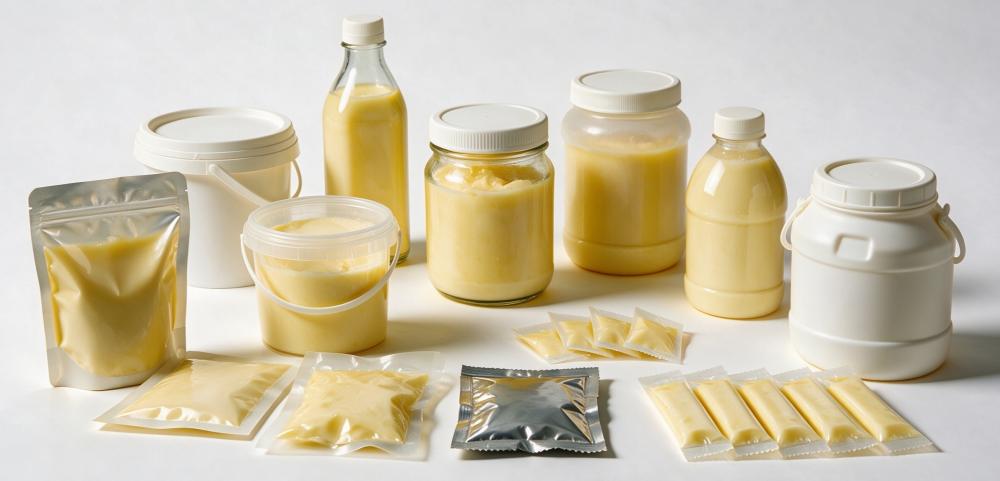
Many overseas dairy B2B buyers classify ghee packing equipment as standard viscous liquid packaging machinery and draw budget comparisons purely based on running speed and pouch dimension compatibility. This simplified assessment ignores the distinct physical traits of clarified butter. Ghee undergoes phase shift with minor temperature variation, easily solidifies inside hoppers and filling channels, develops fat sedimentation, and leaves stubborn residual grease which accelerates bacterial growth if equipment cannot be fully sanitised. Equipment built for syrup or edible oil cannot sustain stable long-run ghee production, yet many buyers opt for these cheaper alternatives to cut upfront expenditure. Drawing on nine years of cross-border dairy packaging line planning, factory commissioning, compliance validation and turnkey project delivery, this article lays out verified market pricing tiers, key cost drivers, frequently overlooked hidden charges, international food safety benchmarks and measurable production ROI examples, delivering practical budget references for dairy manufacturers planning equipment investment.
Combining bulk export order quotation records and standardized manufacturer pricing from 2025 to 2026, ghee packing equipment forms three clear tiers aligned with processing scale, thermal control capacity and export compliance. All listed prices represent complete unit quotations excluding ocean freight, import tariffs and optional extended after-sales service packages.
1.1 Economical Semi-Automatic Tier ($4,500 – $10,200)
Designed for small-batch intermittent production and startup dairy trial runs. These machines adopt ordinary piston dosing without integrated heating jackets, use 201 stainless steel material contact surfaces and rely on manual pouch placement. There is no constant-temperature circulation system; ghee solidification and channel blockages occur frequently under fluctuating workshop temperatures. Long-term filling accuracy fluctuates ±1.3% to ±2.0%. Most units lack complete CE EMC configuration and formal HACCP food safety documentation. Only suitable for local non-export small-volume production with stable indoor ambient temperature.
1.2 Standard Full-Automatic Industrial Tier ($9,600 – $16,800)
This is the mainstream choice for formal export-oriented ghee manufacturing. Constructed with 304 food-grade stainless steel, fitted with servo dosing modules and integrated heating jackets on hoppers and filling channels to prevent ghee solidification. The machine completes film unwinding, pouch forming, filling and sealing in continuous automatic operation, maintaining stable long-run accuracy within ±0.4%. Standard configuration includes CE MD & EMC certification and ISO 9001 documentation. It handles flexible switching between multiple pouch sizes and adapts to normal workshop temperature fluctuations, covering most pouch-format ghee export requirements to South Asia, Southeast Asia and the Middle East.
1.3 Premium Hygienic Continuous Production Tier ($21,500+)
Custom engineered for large-scale dairy factories producing premium branded ghee for supermarket and food processing supply chains. Material contact components utilise 316L mirror-polished stainless steel, equipped with closed-loop constant temperature circulation, anti-sedimentation stirring mechanisms and full CIP online cleaning functions. The whole system complies with HACCP and meets strict food sanitation audit standards. It supports long-hour non-stop operation, minimises fat residue accumulation and greatly reduces manual cleaning labour. This grade is mandatory for exporters supplying large international retail networks and certified organic ghee product lines.
Wide price divergence is not driven by brand premium. It originates from hardware and function customisation required specifically for clarified butter. Every cost reduction on critical components leads to predictable production obstacles during continuous ghee processing.
2.1 Constant-Temperature Anti-Solidification Circulation System (36% of total equipment cost)
Low-cost generic packing machines omit heating jackets and thermal circulation pipelines. Once ambient temperature drops, ghee begins to thicken and block filling pathways, triggering frequent downtime. Industrial dedicated ghee equipment integrates temperature sensors and closed-loop water/oil heating circulation across hopper, transition pipeline and filling nozzle. This thermal control system requires independent sensor modules, heat insulation layers and temperature adjustment algorithms, representing the largest single cost gap between general viscous fillers and specialised ghee machinery.
2.2 Sanitary Grade Material & Surface Treatment (27% of total equipment cost)
Ghee fat adheres strongly to metal surfaces. Thin 201 stainless steel and rough welding leave crevices where residual grease accumulates, turning into contamination risks. Standard industrial models use thickened 304 stainless steel with smooth polished surfaces; premium lines upgrade to seamless 316L structures. Food-safe high-temperature resistant sealing gaskets also carry higher costs compared to ordinary rubber components used on low-priced machines.
2.3 Servo Dosing & Anti-Sedimentation Structure (22% of total equipment cost)
Basic piston fillers cannot compensate density changes caused by fat separation. Premium ghee machines combine servo metering with slow auxiliary stirring inside the heated hopper to stop fat sedimentation. Fixed-stroke mechanical filling found on low-cost equipment cannot adjust dosing volume as material consistency shifts, leading to growing net content deviation during extended shifts.
2.4 International Food Safety & Mechanical Compliance (15% of total equipment cost)
Machinery intended for cross-border dairy shipments needs safety interlocks, overload protection and electromagnetic interference suppression, alongside third-party certification reports. Many low-price suppliers skip certification testing and safety hardware to cut quotations. Uncertified units cannot pass overseas factory audits and risk customs hold for food production equipment.
Most procurement teams only evaluate upfront capital expenditure and overlook recurring operational losses. Summarised from 2024–2025 dairy after-sales data, generic low-cost ghee packing units carry substantial invisible financial burdens throughout their service life.
Frequent blockages and unplanned downtime. Without thermal circulation, solidification stoppages can occur multiple times per shift. Each clearing process disrupts production flow and creates wasted material, lowering overall equipment efficiency significantly.
Consistent batch quality losses. Unstable dosing and intermittent solidification push average defective rates between 3.3% and 4.4%. For medium-volume dairy plants, accumulated wasted ghee and rework expenditure creates thousands in annual losses.
High sanitation risks and audit failure. Rough surfaces without proper polishing trap residual fat. Without CIP capability, thorough cleaning demands extensive manual labour, and residual grease raises microbial test failures which terminate export orders.
Shortened service life of wear components. Temperature cycling and fat adhesion accelerate ageing of cheap gaskets and unpolished metal surfaces. Replacement frequency for wearing parts rises sharply compared to industrial sanitary-grade equipment.
Equipment investment tier directly determines eligibility for overseas dairy product export. Compliance requirements cannot be overlooked during budget planning.
4.1 CE MD & EMC Certification (Minimum Requirement For Cross-Border Shipment)
All industrial tier ghee packing machines must satisfy EU 2006/42/EC machinery directive and EMC standards. Safety interlocks for film breakage, material jamming and overheating must be installed to operate reliably under unstable factory power supply conditions common in emerging markets.
4.2 ISO 9001 & HACCP Food Safety Framework (Formal Dairy Export Standard)
Continuous dairy production requires equipment manufactured under ISO 9001 controlled processes. For food contact applications, machine design must align with HACCP principles to eliminate contamination points, a standard frequently audited by importers in Middle Eastern and South Asian markets.
4.3 FDA Food Contact Material Compliance (Premium Export Grade)
Machinery supplying Western retail networks must provide material certification confirming all surfaces touching ghee meet FDA food contact requirements. Combined with CIP cleaning capability, these specifications are essential for organic and premium branded clarified butter exports.
Case Background: A medium-scale South Asian dairy manufacturer produces pouch-packed ghee targeting regional cross-border export markets. In early 2024, the business purchased 8 sets of economical semi-automatic packing machines at a combined outlay of $36,400. After launch, recurring issues emerged: regular ghee solidification blockages, unstable filling volumes, heavy manual cleaning workload and inability to satisfy HACCP audit demands. Annual losses stemming from downtime, wasted product and missed export contracts reached $34,700.
Budget Optimisation Solution: By mid-2025, the customer replaced all existing units with standard full-automatic temperature-controlled ghee packing machines, with total procurement investment of $79,200. Each unit comes equipped with heating circulation channels, servo adaptive dosing and 304 polished sanitary construction, fully certified for export dairy production.
Verified On-Site Operational Data: Following three months of continuous commissioning and stable operation, overall defective rates fell from 3.8% down to 0.27%. Unplanned downtime caused by ghee solidification dropped by 81%, while hourly effective production output increased by 22%. The payback period on additional equipment investment reached 1.7 years. The upgraded line successfully passed multiple international buyer sanitation audits and enabled expansion of long-term cross-border distribution agreements.
Drawing from years of overseas dairy production line commissioning, sanitation audit coordination and process optimisation, these guidelines help dairy processors avoid costly procurement mistakes:
1. Avoid generic viscous liquid fillers for dedicated ghee production. Machinery built for oil, syrup or honey lacks anti-solidification thermal control. Upfront savings will be offset by constant blockages and quality inconsistencies.
2. Make constant-temperature circulation a non-negotiable specification. Any factory operating under variable ambient temperatures must prioritise machines with heated hoppers and filling channels. This single feature defines long-run production stability for clarified butter.
3. Assess full lifecycle costs instead of only initial quotation. Compare projected waste, maintenance labour and downtime losses alongside machine price. Low quotations often hide steep recurring operational expenses.
4. Confirm complete food safety documentation for export orders. Request CE test reports, stainless steel material certificates and gasket food contact compliance before finalising contracts. Missing documentation creates customs and audit risks.
5. Reserve extra budget if producing multiple package formats. Multi-size pouch production requires modular quick-change assemblies and pre-stored parameter templates, which add engineering cost but reduce lengthy changeover downtime.
Q1: Why is there such a large price gap between ghee packing machines and ordinary oil filling equipment?
A: Standard oil packing machines require no thermal management. Ghee changes viscosity and solidifies with minor temperature shifts, requiring integrated heating circulation systems, temperature sensors and insulated channels. This dedicated thermal hardware creates the primary price separation; simple metering structures alone cannot satisfy ghee processing demands.
Q2: What price tier offers the best value for medium-sized dairy export manufacturers?
A: The standard full-automatic industrial tier ranging $9,600 – $16,800 delivers balanced investment and performance. It includes essential anti-solidification heating systems, maintains stable filling precision and carries complete export compliance documentation suitable for most cross-border ghee pouch operations.
Q3: Can I operate ghee packing machines without heating jackets if my workshop maintains steady high temperatures?
A: Short-term trial runs may appear stable, yet small localised cooling inside filling channels still causes partial solidification and uneven dosing during extended shifts. For consistent export-grade quality, temperature circulation systems remain recommended regardless of ambient workshop conditions.
Q4: What certifications do ghee packing machines require for exports to Middle Eastern and South Asian dairy markets?
A: Mandatory documentation includes CE machinery safety and EMC certification. Dairy buyers commonly request HACCP-aligned structural design evidence and food contact material test certificates to pass factory sanitation audits.
Q5: Are CIP cleaning systems worth the extra investment for ghee production?
A: CIP delivers clear advantages for large-scale continuous factories running daily multi-batch production. Small-batch intermittent processors may manage thorough manual cleaning, though residual grease contamination risks remain higher without automated circulation washing.
Written by Helen Xu | Chief Industrial Application Engineer
Helen Xu is a Chief Industrial Application Engineer with 9 years of specialized experience in packaging machinery and liquid filling machine design, equipment model selection, and full production line process optimization. She focuses on delivering customized packaging & filling solutions for pharmaceutical, food, and chemical manufacturing industries, with mature practical expertise in GMP compliance, ISO 9001 quality management standards, and turnkey large-scale filling & packaging production line integration.
E-mail Us
Chat With Us


