
-
E-mail
-
WhatsApp & WeChat
WhatsApp & WeChat
 Blister Packaging Line
 Automatic Counting Machine Line
 Liquid Filling Machine Line
 Powder Filling Machine Line
 Granule Filling Machine Line
 Bag Packing Machine
+86 151 6187 8967
Dry Powder Packaging Equipment
Buying dry powder packaging equipment is a containment-class decision before it is a speed decision. The bags-per-minute figure on a quotation tells you nothing about whether the operator breathing zone will pass an exposure survey, whether your filter house becomes an ATEX zone, or whether a colour change eats forty minutes of every shift. I have started up a 120 bags/min line that settled at 55 because the cartridges blinded every three hours, and watched a 40 bags/min line hold 88 % OEE because the powder was measured first.
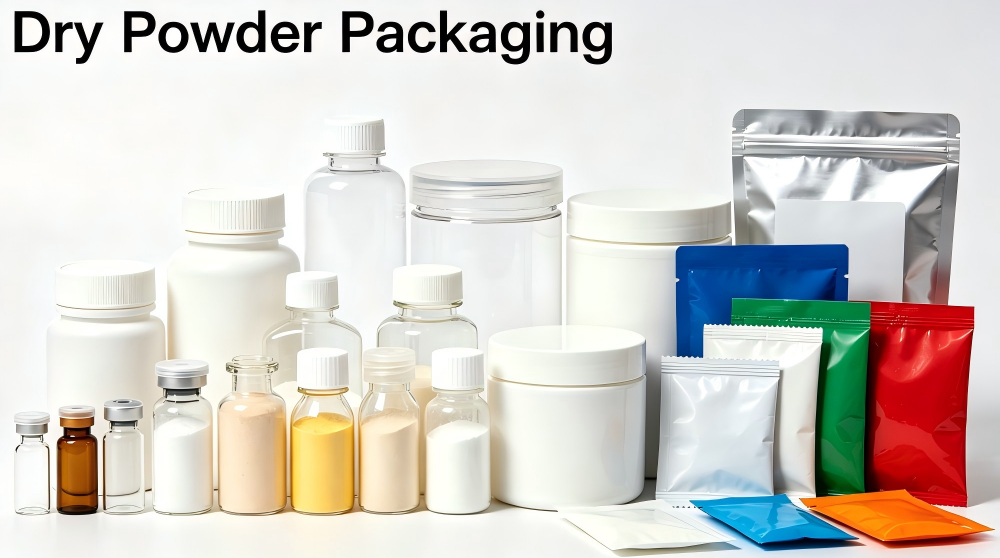
Dry Powder Packaging Equipment
Nearly every containment failure I have been called to fix started with a missing number. Vendors quote against free-flowing, non-hygroscopic, non-combustible powder, because that is what their test hopper holds. Half a day on this sheet disqualifies half the quotations you receive.
| Parameter | How we measure it | What it decides on the machine |
|---|---|---|
| Bulk and tapped density | 250 mL cylinder, 100 and 1,000 taps | Hopper outlet, auger pitch, de-aeration spout |
| Carr index / Hausner ratio | Hausner = tapped ÷ bulk | Bridging risk, cone angle, agitation |
| Particle size distribution | Laser diffraction, % below 63 µm | Media class, seal contamination |
| Moisture | Loss on drying at 105 °C, or Karl Fischer | Caking, dry or wet clean |
| Fat or oil content | Soxhlet extraction or supplier CoA | Jaw smearing, wet wash |
| Electrostatic behaviour | Charge decay, volume resistivity | Film cling, ionised air |
| MIE, Kst, St class, MIT | Test house, if combustible | ATEX zoning, venting, isolation |
Two thresholds I carry onto site. A Hausner ratio above 1.35 means you will fight bridging in any hopper with a cone half-angle steeper than 60°, and a vibratory pad will not save it. Above roughly 8 % fines below 63 µm, dust escapes a standard shroud and seal contamination becomes a leak defect, because particles in the seal channel hold it open.
Exposure performance is bought in steps, and each step roughly doubles the cleaning bill. The figures below are 8-hour time-weighted averages from our own surveys on active products. Read them as design targets: the spread inside a tier comes from operator technique as much as from hardware. On food powder the same kit is measured in mg/m³, three orders of magnitude higher, because the limit is a different one.
| Tier | Typical 8-h TWA | Capital ratio | Cleaning burden | Where we use it |
|---|---|---|---|---|
| Local exhaust hood at the spout | 200–800 µg/m³ | 1.0 (baseline) | 10–15 min wipe-down | Non-hazardous food powder, low fines |
| Downflow booth | 30–150 µg/m³ | 1.8–2.4× | 20–30 min | High-volume food powder, allergens |
| Glovebox / restricted-access barrier | 5–30 µg/m³ | 2.6–3.6× | 30–45 min plus glove integrity checks | OEB 3 to 4 actives |
| Full isolator, negative pressure, WIP | 0.2–5 µg/m³ | 4–6× | 45–90 min validated cycle | OEB 5, cytotoxics, pre-aseptic powder |
The common mistake is choosing the tier from the exposure limit and then finding the qualification package costs as much as the steel.
Three numbers decide whether a collector works, and they live in the duct, not in the brochure. Face capture velocity of 0.5–1.0 m/s at the shroud opening, because below 0.4 m/s the plume rolls back at the operator. Duct transport velocity of 18–20 m/s, or you lay a bed in the horizontal runs and rod them out at weekends. Air-to-cloth ratio of 1.0–1.5 m/min with H13 media on fine cohesive powder, because past 2.0 the pulse cannot release the cake and the hood quietly stops capturing.
H13 to EN 1822 is the default wherever air returns to the room or the product is potent. Pleat geometry and a PTFE membrane do more for cartridge life than the class label does. Pulse cleaning should trigger on differential pressure rather than a timer, at 5–6 bar of dry instrument air with pulses near 100 ms.
Return air against once-through is an energy question. Recirculating 3,600 m³/h into a conditioned room recovers roughly 17 kW at a 12 K difference, about €11,000 a year at 6,000 hours and €0.11/kWh. That is why most food plants recirculate, and why potent or combustible dust cannot.
Where the dust will burn, get Kst and the St class from a test house and size venting from them, add suppression and isolation on any duct running back into the building, and specify equipment to Directive 2014/34/EU with the workplace assessment to 1999/92/EC. I have seen two projects stop ship because the filter house was added after the zone had already been drawn.
Dry vacuum takes 8–15 minutes and only works when the product is dry and not greasy. Wet wash takes 30–60 minutes plus drying, needs drainage and IP65 or better, and is the only real option once fat content passes roughly 15 %. Clean-in-place takes 20–40 minutes and is the only one you can validate, but it demands fully drainable pipework and spray coverage proven by a riboflavin test.
Limits are set differently depending on what you are removing. For an active, the swab limit derives from the 1/1000 minimum therapeutic dose or the 10 ppm rule, then gets expressed as micrograms per swab over a defined area, commonly 25 cm², and enforced against a swab map that includes the auger flight root. For allergens there is no universal EU ppm threshold, so the limit comes from your own risk assessment, verified by protein swab.
Design is what moves the number: crevice-free orbital welds ground flush, Ra ≤ 0.8 µm on contact surfaces, no ledges or blind holes, quarter-turn strip-down. On one spice plant we cut a colour change from 55 to 32 minutes by replacing 24 M6 bolts with four quarter-turns.
Ask for this in the RFQ, not after the FAT. EN 10204 3.1 certificates for every product-contact steel item, a weld map with the WPS and PQR behind it, surface finish reports, and calibration certificates for the load cells. Qualification follows the design, installation, operational and performance sequence set out in EU GMP Annex 15, and the OQ protocol should arrive in English with acceptance criteria filled in. Add ISO 9001, ISO 13485 where the line serves medical device work, and CE conformity under Machinery Regulation (EU) 2023/1230 or UKCA.
The pitfall I see most is a spec sheet signed with no FAT clause, no named change parts, and no spare-parts lead time in writing. The line then waits eight weeks for a heater cartridge.
On a line we costed at €310,000, the five-year operating bill came to roughly €470,000.
| Cost line | Per year | Five years |
|---|---|---|
| Extraction fan, 11 kW at 6,000 h | €7,260 | €36,300 |
| Conditioning penalty for once-through air | €11,220 | €56,100 |
| Filter cartridges, 12 units, two changes | €3,360 | €16,800 |
| Cleaning labour, 2 operators, 55 min, 250 days | €12,800 | €64,000 |
| Changeover downtime, 3 per shift at €95/h | €59,400 | €297,000 |
Changeover alone is half the total and appears in no machine quotation.
A creamer plant outside Ho Chi Minh City runs 500 g pillow pouches at 42 per minute on two eight-hour shifts, 250 days a year, with a 25 kg bagging line alongside. The product carries 33 % fat and the packing hall sits at 31–34 °C with 75–85 % RH through the wet months. That humidity was the whole problem.
Conditioned samples told the story before we touched a machine: Carr index 22 at 55 % RH, 31 at 80 % RH. Hoppers bridged 14 times a shift, operators rodded them, and every rod was a dust release. Inhalable dust at the operator measured 3.8 mg/m³, seal rejects ran at 2.6 %, OEE at 61 %.
We changed four things: conveying and instrument air dried to a 5 °C dew point, an insulated hopper with a 65° cone and a flexible-wall agitator, a downflow booth over the fill head feeding a once-through H13 collector, and a suction clean-off at the jaw. Measured over a three-shift trial and re-checked three months later: stoppages down to one or two a shift, dust at 0.4 mg/m³, seal rejects at 0.5 %, cleaning at 32 minutes, OEE at 78 %.
What exposure number belongs in the RFQ?
State the occupational exposure band and demand a measured result at FAT, not a design claim. Ask for the method too: sampling type, 8-hour TWA, sampler model. A vendor who will not commit to a number at FAT has not built the tier you asked for.
Does a food powder ever need ATEX-rated equipment?
Yes, if the dust is explosible, and you cannot tell by looking. Milk powder, creamer, sugar, flour and many spices form ignitable clouds. Get MIE, Kst and minimum ignition temperature from a test house before specifying, because the answer changes the motors, the earthing, and where the collector sits.
Can filtered air go back into the room?
Only with H13 media behind a safe-for-return argument, and never for potent or combustible dust without isolation and a written assessment. Weigh the recovered load, about 17 kW on a 3,600 m³/h system, against the extra filtration.
How do I set a carryover limit when allergens and actives share a line?
Set them separately and design to the stricter one. The active limit comes from the therapeutic dose calculation, the allergen limit from your own risk assessment verified by protein swab. One generic "clean" criterion will silently let the wrong one govern.
Which certificates matter at handover?
EN 10204 3.1 for product-contact steel, the weld documentation package, surface finish reports, calibration certificates, and English-language DQ/IQ/OQ/PQ protocols with acceptance criteria already written. Then ISO 9001, ISO 13485 where relevant, and CE or UKCA conformity.
How much does containment add to the price?
From our own quotations, a downflow booth runs 1.8 to 2.4 times a local hood and a full isolator 4 to 6 times, before qualification. Cleaning labour roughly doubles at each step, so overspending slightly on the tier beats buying too little.
Written by Helen Xu | Chief Industrial Application Engineer
Helen Xu is a Chief Industrial Application Engineer with 9 years of specialized experience in packaging machinery and liquid filling machine design, equipment model selection, and full production line process optimization. He focuses on delivering customized packaging & filling solutions for pharmaceutical, food, and chemical manufacturing industries, with mature practical expertise in GMP compliance, ISO 9001 quality management standards, and turnkey large-scale filling & packaging production line integration.
E-mail Us
Chat With Us


