
-
E-mail
-
WhatsApp & WeChat
WhatsApp & WeChat
 Blister Packaging Line
 Automatic Counting Machine Line
 Liquid Filling Machine Line
 Powder Filling Machine Line
 Granule Filling Machine Line
 Bag Packing Machine
+86 151 6187 8967
Dry Powder Filling Machine
A dry powder filling machine built for rigid containers has almost nothing in common with a sachet line, and the buyers who get hurt are the ones who priced the two against each other. The sachet machine makes its own package and never touches a container; a rigid-container filler must receive, orient, hold still, fill without dusting the sealing surface, and hand the container over to a capper. Then the whole question splits again, because filling 1 g of a sterile antibiotic into a vial under EU GMP Annex 1 and filling 100 g of protein powder into a jar are two separate industries sharing a word.
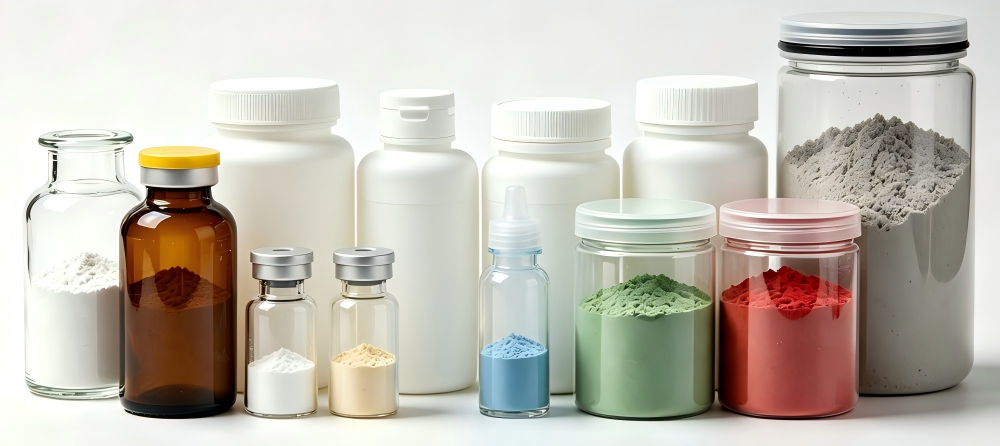
Dry Powder Filling Machine
Most dosing problems blamed on the filler actually start upstream at the feed.
Feed method. Round, robust containers come off a centrifugal unscrambler at 100-400 containers per minute. Vials, and especially ready-to-use nested vials delivered in tubs, go through a de-nesting station instead, because glass-on-glass handling generates particles and you cannot afford them in a Grade A zone. Small, unstable or tapered containers are better on a tray or puck feed.
Indexing versus continuous motion. Indexing (star wheel or walking beam) is simpler and cheaper, and it suits larger fills where the dose takes over a second. Continuous motion with a timing screw and pocketed belt is the choice above roughly 120 containers per minute, or whenever the fill needs to happen on the move.
Neck gripping beats body gripping. Handling the container by its neck means the body diameter barely matters, so a diameter changeover is often just a guide rail and a timing screw. It also avoids scuffing labelled or printed containers. Anti-rotation is a separate requirement: if a threaded neck has to be oriented before capping, that has to be done before the fill station, not after.
Static on plastic. HDPE and PET jars arrive charged. Powder jumps away from the fill funnel and clings to the jar rim, and a dirty rim is a failed induction seal later. An ionising blower ahead of the fill station and a grounded filler frame are cheap insurance; on one line this alone cut seal rejects by more than half.
Changeover deserves a number in the contract. A well-specified machine changes height and diameter in 15-45 minutes using tool-less adjustments and a colour-coded format set. Ask how many format parts are included in the base price, because that is where quotations are quietly trimmed.
| Principle | Fill range | Speed | Realistic tolerance | Where it belongs |
|---|---|---|---|---|
| Auger in funnel, volumetric | 1 g - 1 kg | 20-80 per min | ±1-2% of target | Nutraceutical and food jars, cohesive powder |
| Vacuum or pressure drum | 0.1 - 100 g | 100-300 per min | ±2-5% | High-speed vials, free-flowing sterile powder |
| Vacuum venturi with gas assist | 10 mg - 5 g | 40-200 per min | ±1-3% | Small pharmaceutical doses, expensive API, near dust-free transfer |
| Twin-stage bulk and dribble with gravimetric trim | 50 g - 2 kg | 15-60 per min | ±0.2-0.5% | Coffee, protein, milk powder, detergent in jars |
| Load-cell net weigh into the container | 20 g - 25 kg | 8-40 per min | ±0.1-0.3% | High-value product, legal-for-trade duty |
The vacuum venturi row is the one buyers miss. It pulls a metered dose into a bore by vacuum, then blows it into the container with filtered gas, so the powder never passes through a mechanical seal above the open vial. For a potent or moisture-sensitive compound it generates almost no dust and wastes very little product, which matters when the API costs more per gram than the vial.
On any fill above about 50 g, the bulk stage is there to save time and the dribble stage is there to hit the target. Bulk typically runs to 85-92% of target at high rate, then dribble tops off. Everything that ruins accuracy happens in those last few grams.
Three mechanisms. First, in-flight material: the powder still in the air between the feeder and the container when you shut off. On a 500 g fill at high bulk rate this can be 2-6 g, so the controller has to cut the feed early, and the cut point has to be learned per product. Second, shut-off repeatability: a knife gate that sticks or dribbles is worse than a slow one, and pneumatic actuators with worn seals drift over a shift. Third, de-aeration: a freshly filled jar holds a fluidised powder column that settles as the air escapes, so the weight you read at the fill station is not always the weight you read downstream.
A practical rule I work to: dribble rate should be 5-12% of the bulk rate. Slower than that and you eat cycle time; faster and the shut-off error becomes the dominant term. Then allow a settle time before the checkweigher reads, and make sure the checkweigher stands far enough downstream that the powder has finished collapsing, or your feedback loop will chase a phantom.
Powder escaping the container mouth costs you product, contaminates the sealing surface, and in the worst case creates an explosive atmosphere. All three are engineering problems, not housekeeping slogans.
This is the fork in the road, and it changes the machine more than any other decision.
For sterile powder filling into vials, the open product and the open container must sit in a Grade A environment, delivered either by a RABS with a Grade B background or by a closed isolator, under EU GMP Annex 1. An isolator brings a validated vapour-phase hydrogen peroxide bio-decontamination cycle, typically two to three hours including aeration, validated against biological indicators. What that does to the machine design:
A non-sterile jar line has none of that. One hundred grams of protein powder into a 1 L HDPE jar at 40 jars per minute runs on an open auger filler with local extraction. The risks are dose variation, dust on the jar rim, and a capper that does not hold torque. The complications that matter are environmental: in a humid plant, and I have seen this in Indonesia and in coastal India, powder picks up moisture over a shift and the bulk density moves, which shows up as a drift in mean fill weight that only a checkweigher will catch.
Everything after the fill head exists to prove the dose and protect the seal. An in-line checkweigher, 100% or statistically sampled, with a feedback trim to the filler. Metal detection or X-ray: choose X-ray where the container is aluminium or where you need to detect dense non-metallic contaminants and missing scoops, and metal detection where the product is dry and the container is plastic or glass. Then capping with torque monitoring, an induction sealer with a foil liner and a defined power and dwell window, labelling, and coding.
Two things buyers forget. First, reconciliation: rejected units must be counted, and good plus rejected plus sampled must equal input. An unreconciled count is how a mix-up stays invisible. Second, seal integrity testing at a defined frequency, by vacuum decay or by visual and torque checks, rather than hoping the sealer is doing its job.
Regional note: EU buyers will expect a CE declaration under the Machinery Regulation (EU) 2023/1230 plus a full GMP documentation set in English. Plants in India and Southeast Asia typically work to WHO-GMP and PIC/S expectations, while Brazil's ANVISA expects equipment validation documentation in Portuguese or bilingual. Confirm the documentation language and the local service engineer in the purchase order, not after FAT.
Jar line, Southeast Asia. A nutraceutical packer near Jakarta filled 100 g of whey protein isolate into 1 L HDPE jars at 40 jars per minute, two shifts, in a plant running at 30-33 °C with high ambient humidity. The original line used a single-stage volumetric auger with no trim: mean fill 101.6 g, standard deviation 1.5 g, CV 1.5%, giveaway 1.6%, and 0.9% of jars rejected after induction sealing because of powder on the rim. We converted to twin-stage bulk and dribble with gravimetric trim on a load cell under the filling station, added in-flight compensation, an ionising blower and shrouded extraction at the fill point, and an air knife over the rim before capping. Measured over a four-week period: mean 100.4 g, σ 0.42 g, CV 0.42%, giveaway 0.4%, seal rejects down to 0.06%, format changeover at 26 minutes.
Vial line, EU. A sterile facility filled 1 g of a cephalosporin antibiotic into 20 ml tubular glass vials at 90 vials per minute, from nested tubs through de-nesting, vacuum-venturi dosing, stoppering and capping, inside an isolator with VHP bio-decontamination. Fill target was 1,050 mg, measured mean 1,050.8 mg, σ 7.9 mg, CV 0.75%, with 100% in-process checkweighing and an automatic reject on any vial outside ±3%. Particle counts in the filling zone were monitored continuously and stayed within the Grade A limit, and the qualification campaign ran three consecutive media fills of roughly 5,200 units each with no positive units. The single biggest time sink was not the filler: it was glove-port ergonomics during intervention trials, which is why I now ask operators to walk the intervention list during the design review rather than at FAT.
Can one machine do both my 100 g jar and my 1 kg tub?
Usually not well. The auger and the change parts differ, but the real limit is cycle time: a 1 kg fill needs seconds of dose time, so the filler you sized for 40 jars per minute at 100 g will not hold that rate at 1 kg. Specify the largest fill weight and the rate you need at that weight.
Do I need an isolator?
For sterile products, the choice is between a RABS with a Grade B background and an isolator. The isolator costs more up front and adds a decontamination cycle, but it lowers the background room grade and, in my experience, makes the aseptic process simulation easier to pass. For non-sterile food and nutraceutical product, neither: local extraction and good dust control are enough.
How do I avoid dust on the sealing surface?
Shrouded extraction at the fill point, an anti-static blower before filling, an air knife or vacuum nozzle cleaning the rim before capping, and a fill funnel that discharges below the rim, not across it.
What fill accuracy should I write into the contract?
State the fill weight, the product, the tolerance as a standard deviation with a stated sample size, and the giveaway you will accept. Then require the same test at SAT on your floor with your powder. A tolerance quoted only at FAT is not a commitment.
Which containers need special handling?
Thin-walled HDPE, tapered jars, and any container with a wide body and narrow neck. Give your supplier real container samples, at least 200 pieces with dimensional tolerances from your moulder, before the machine is designed.
What spares should be on the shelf on day one?
Auger or dosing piston sets, funnel or venturi bores, flap or gate seals, load cell, extraction filters and the format parts for your second container. Ask for lead times in writing; a spare auger held locally is worth more than a faster machine that waits three weeks for a part.
Written by Helen Xu | Chief Industrial Application Engineer
Helen Xu is a Chief Industrial Application Engineer with 9 years of specialized experience in packaging machinery and liquid filling machine design, equipment model selection, and full production line process optimization. He focuses on delivering customized packaging & filling solutions for pharmaceutical, food, and chemical manufacturing industries, with mature practical expertise in GMP compliance, ISO 9001 quality management standards, and turnkey large-scale filling & packaging production line integration.
E-mail Us
Chat With Us


