
-
E-mail
-
WhatsApp & WeChat
WhatsApp & WeChat
 Blister Packaging Line
 Automatic Counting Machine Line
 Liquid Filling Machine Line
 Powder Filling Machine Line
 Granule Filling Machine Line
 Bag Packing Machine
+86 151 6187 8967
Jul. 24, 2026
Yes, a standard powder machine can handle multiple bag or bottle sizes within its specified mechanical limits, but no single unit seamlessly processes both soft pouches and rigid bottles without dedicated modular sub-assemblies.
Mechanical changeovers for same-format containers take 15 to 45 minutes, whereas switching between non-compatible container media or vastly different powder chemistries can require up to 2 hours due to deep-cleaning protocols and offline mechanical reconfiguration.
As a packaging project engineer, I frequently see overseas plant managers purchase a "universal" machine expecting a 5-minute push-button changeover across 50g pouches and 2kg rigid bottles—only to encounter severe throughput bottlenecks, seal failures, or cross-contamination.
Here is the engineering reality of multi-size powder packaging, the physics of format changes, and how to avoid costly downtime.
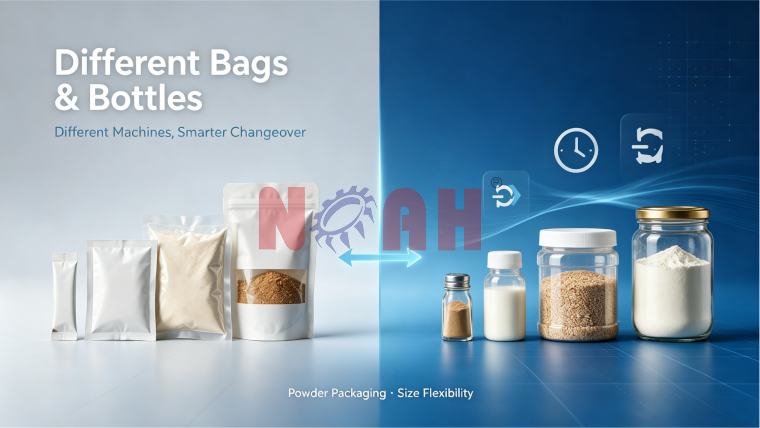
Powder packaging machinery is governed by physical constraints: container geometry, feeding method, and sealing dynamics.
                                  +-----------------------+
                                  |   Servo Auger Dosing  |
                                  |     (Common Head)     |
                                  +-----------+-----------+
                                              |
                     +------------------------+------------------------+
                     |                                                 |
         +-----------v-----------+                         +-----------v-----------+
         |  Flexible Bag Module  |                         |   Rigid Bottle Line   |
         +-----------+-----------+                         +-----------+-----------+
                     |                                                 |
      +--------------+--------------+                   +--------------+--------------+
      |                             |                   |                             |
+-----v-----+                 +-----v-----+       +-----v-----+                 +-----v-----+
| VFFS Film |                 | Premade   |       | Conveyor  |                 | Rotary    |
| Forming   |                 | Pouch     |       | & Star    |                 | Capping & |
| Collar    |                 | Grippers  |       | Wheel     |                 | Induction |
+-----------+                 +-----------+       +-----------+                 +-----------+
Dimensional Range: Most automated rotary premade pouch machines handle widths from 100 mm to 300 mm and lengths up to 400 mm. Vertical Form-Fill-Seal (VFFS) units handle variable lengths digitally via servo pull belts, but width changes require swapping the mechanical forming collar/tube assembly.
Sealing Mechanism: Uses heated seal jaws (impulse, constant, or ultrasonic). Seal jaw stroke, pressure dwell, and temperature profiles must adjust to varying film thicknesses (e.g., 80µm PET/PE vs. 120µm aluminum foil laminate).
Dimensional Range: Bottle packaging handles variable heights via motorized filling head elevators, and varying diameters via adjustable conveyor rails or quick-change star wheels.
Sealing Mechanism: Relies on screw capping, press-on caps, or electro-magnetic induction sealing (foil liners under caps).
Not on a single monoblock frame. Heat-sealing jaws designed for flexible films cannot apply targeted torque to a bottle screw cap. However, the upstream dosing system is universal.
A standard setup utilizes a single Servo Auger Dosing System mounted on a gantry, which pivots between or swaps below a pouch-handling chassis and a bottle conveyor line.
In accordance with Lean SMED (Single-Minute Exchange of Die) frameworks, changeover duration is broken down into four distinct phases: Shutdown & Clean-down, Tooling Swap, Calibration & Recipe Loading, and Trial Run Validation.
| Changeover Level | Duration | Operations Included | Typical Trigger Scenario |
| Level 1: Minor Size Change (Same product, same bag type, different length/volume) | 10 - 15 mins | Load PLC recipe, adjust HMI servo stroke, fine-tune hopper level sensors, adjust bag magazine rails. | 250g whey protein to 500g whey protein in stand-up pouches. |
| Level 2: Major Format Change (Same product, different bag width or bottle diameter) | 30 - 45 mins | Swap forming collar (VFFS) or star wheels/grippers, change auger screw/funnel, adjust sealing jaw height. | 100mm wide flat sachet to 220mm wide zipper pouch. |
| Level 3: Cross-Product Changeover (Different powder chemistry + different container size) | 90 - 120 mins | Full wet/dry clean-down of auger, split hopper, and dust extraction ducts; swap tooling; full weight calibration. | Fine cocoa powder (high fat) to fine pharmaceutical-grade powder (zero contamination). |
While changing a forming collar takes 5 minutes with tool-less quick-clamp systems, powder hygiene and dust control consume up to 70% of total changeover downtime.
Total Changeover Time: 60 Minutes (Example: Standard Level 2/3 Swap)
[■■■■■■■■■■■■■■■■■■■■■■■■■■■■■■] Clean-Down & De-dusting (35 mins)
[■■■■■■■■■■] Tooling & Mechanical Swap (12 mins)
[■■■■■] PLC Recipe & Servo Calibration (8 mins)
[■■■■] Test Run & Seal Integrity Audit (5 mins)
Dust Migration into Sealing Jaws: Fine particulate powders (like titanium dioxide or milk powder) settle on thermal sealing surfaces. When switching pouch sizes, residual dust prevents proper film fusion, leading to micro-leaks.
Bulk Density Variability: Switching from a dense powder (0.8g/cm3) to a fluffy, aerated powder (0.3g/cm3) requires swapping the inner auger screw pitch. Running a fluffy powder with an oversized auger results in aeration, static build-up, and extreme weight deviation.
To ensure long-term international trade compliance and export readiness, multi-format powder packaging equipment must meet stringent international engineering standards:
CE Machinery Directive 2006/42/EC & Low Voltage Directive 2014/35/EU: Mandatory for European market access, ensuring operator safety during manual tooling swaps (interlocked safety gates, zero-energy state lockout/tagout).
ISO 21524 / ISO 14644 (Cleanroom Compatibility): Critical for pharmaceutical and nutraceutical powder lines where changeover procedures must avoid generating airborne particles during component disassembly.
ASTM F88 / F88M (Standard Test Method for Seal Strength of Flexible Barrier Materials): Every format changeover must be validated using ASTM F88 peel testing. Changing bag thickness or width alters heat transfer rates; seal strength must meet minimum thresholds (typically > 15 N/15 mm for heavy powder loads) before production resumption.
ASTM F2096 (Bubble Emission Testing): Used post-changeover to verify that heat-sealing jaws do not cause micro-punctures along zipper gussets or thick pouch seams.
Client Overview: An OEM contract packager in Poland running sports nutrition powders.
Problem: The client utilized a legacy VFFS system with bolt-on forming sets. Switching between 100g, 500g, and 1kg pouches took 2.5 hours per shift, dropping Overall Equipment Effectiveness (OEE) below 52%.
Engineering Intervention:
Installed a servo-driven, tool-less quick-change VFFS system featuring pneumatic snap-locks for forming collars.
Retrofitted an IP65 washdown-rated split-hopper design, allowing operators to swing open the dosing chamber and swap the auger in under 4 minutes without removing drive belts.
Implemented a closed-loop pneumatic dust extraction manifold integrated directly around the lower funnel spout.
Measured Results:
Mechanical format swap time dropped from 45 minutes to 8 minutes.
Cleaning and de-dusting time reduced from 75 minutes to 22 minutes.
Overall changeover time dropped from 150 minutes to 30 minutes.
Line OEE increased by 21.4% within 60 days of deployment.
When specifying a multi-size powder machine with overseas manufacturers, inspect the following technical features:
Tool-less Quick-Release (TLQR): Demand pneumatic or lever-action clamps for forming collars, guide rails, and auger funnels. Bolt-on assemblies add 20–30 minutes to every shift change.
Servo-Driven Mechanical Adjustments: Ensure pouch grippers or bottle star-wheels feature auto-positioning via HMI input, rather than manual hand-cranks.
Split or Clamshell Hopper: Never buy a fully welded, single-piece hopper for a multi-product line. Cleaning internal corners without disassembling the drive shaft is nearly impossible and leads to cross-contamination.
HMI Recipe Memory (Minimum 50+ Profiles): The PLC must store auger rotation speeds, vibration frequencies, seal temperatures, and stroke lengths for each container spec. Manual re-calibration wastes material during setup.
No. Dosing accuracy depends on the ratio between auger flight diameter and container neck opening. Using a small auger (designed for 100g) to fill a 5kg bag takes too long, causing line starvation. Using a large 5kg auger for a 100g pouch causes severe over-filling and weight fluctuation beyond acceptable statistical process control (SPC) limits.
Zippered stand-up pouches (Doypack) require an dedicated mechanical zipper-opening blade and top-seal crusher jaws. When changing pouch widths, ensure the zipper opener unit is mounted on a linear slide rail with a digital position indicator (Siko counter) for fast, repeatable alignment.
Thermal mass differs across pouch sizes and film structures. Larger pouches often use thicker laminates requiring higher sealing pressure and dwell time. Always clear residual powder dust from seal jaw serrations and allow sealing bars to reach thermal equilibrium (at least 5–10 minutes after changing setpoints) before performing an ASTM F88 seal-strength test.
Related Products
Chat With Us


