
-
E-mail
-
WhatsApp & WeChat
WhatsApp & WeChat
 Blister Packaging Line
 Automatic Counting Machine Line
 Liquid Filling Machine Line
 Powder Filling Machine Line
 Granule Filling Machine Line
 Bag Packing Machine
+86 151 6187 8967
Jul. 24, 2026
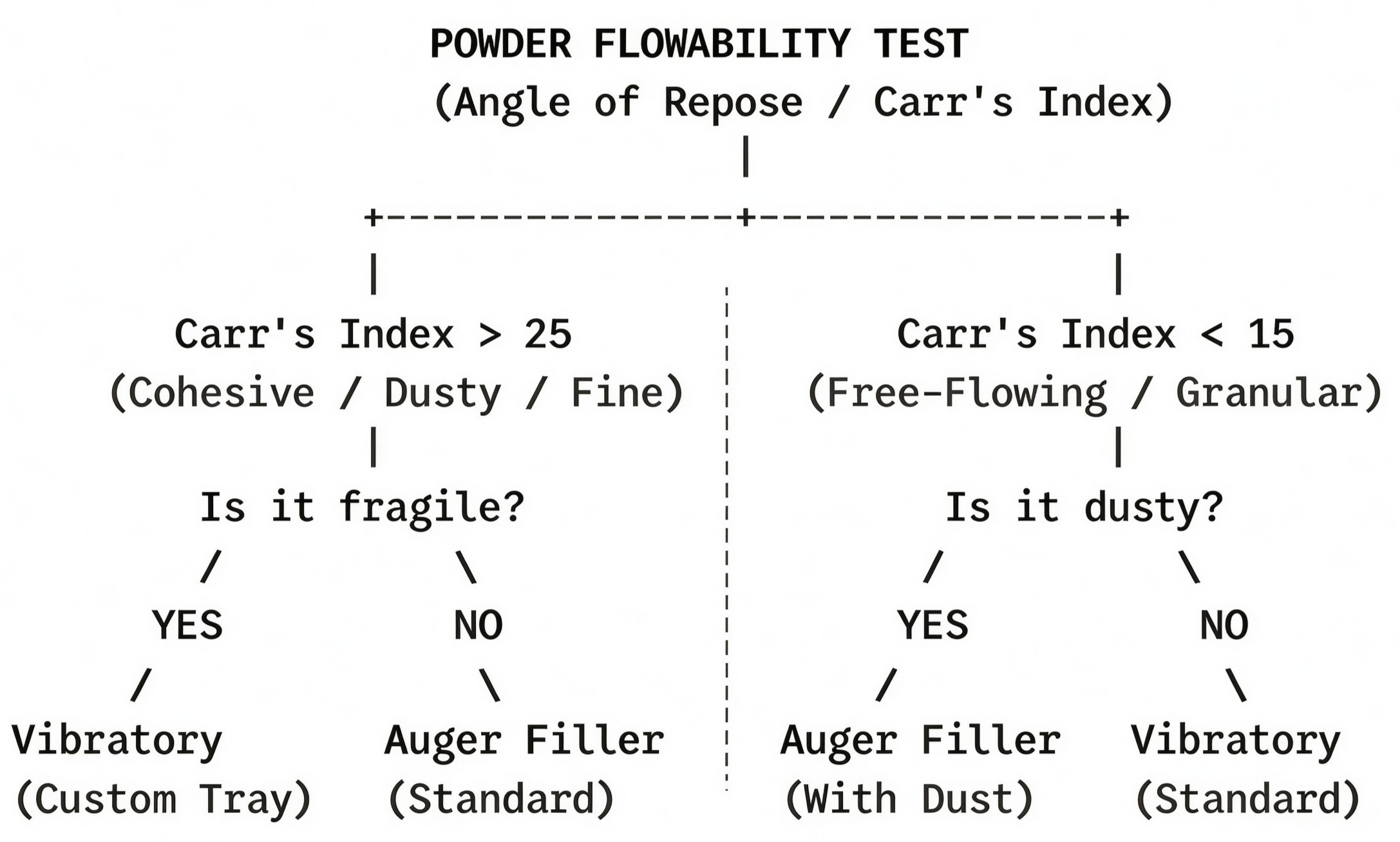
An auger filler is the correct choice for non-free-flowing powders, fine dusty materials, and high-speed bulk volume fills, whereas a vibratory filler is superior for free-flowing, fragile, or unevenly sized granules that degrade under mechanical shear.
Choosing between these two technologies is rarely a matter of machine preference; it is dictated by fluid dynamics, particle morphology, and structural shear sensitivity.
Using the wrong dosing method directly causes off-spec weight variances, excessive dust migration, product degradation, or costly giveaway.
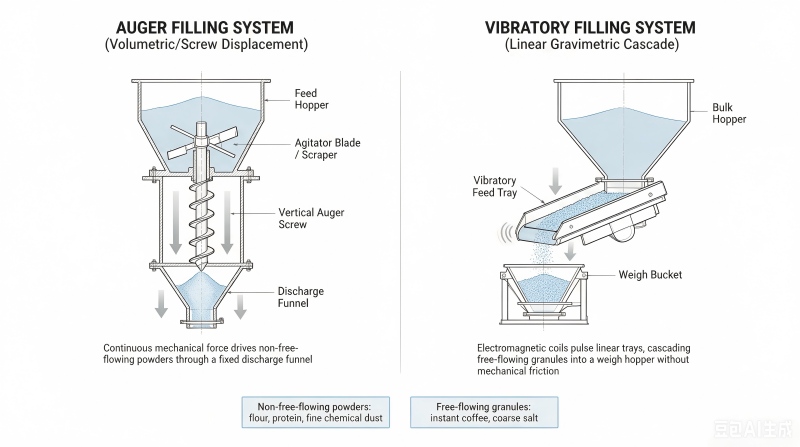
Understanding the fundamental mechanics of both systems reveals why they perform differently depending on the physical properties of your powder.
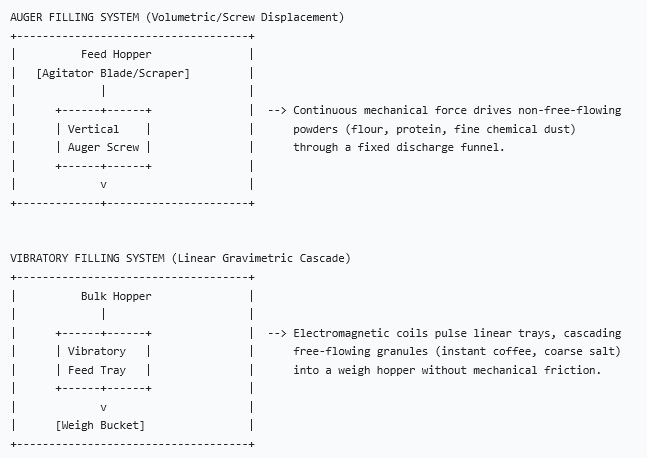
Auger fillers rely on a precision-machined vertical screw rotating inside a fitted funnel. A separate agitator blade sweeps the hopper walls to break bridging and maintain consistent bulk density.
Primary Dosing Principle: Volumetric displacement (or gravimetric when paired with a gross-weight load cell under the funnel).
Target Material Behavior: Non-free-flowing, compressible, adhesive, or ultra-fine powders (e.g., milk powder, cocoa, whey protein isolate, starch, talc, titanium dioxide).
Core Advantage: High-speed positive displacement forces cohesive powders downward without relying on gravity alone.
Vibratory fillers utilize electromagnetic coils to pulse linear trays, causing granules to "bounce" forward along a decline into a weigh bucket.
| Evaluation Metric | Servo Auger Filler | Vibratory Net-Weigh Filler |
|---|---|---|
| Dust Containment | Excellent (Enclosed funnels & vacuum collection) | Fair to Poor (Open tray vibration disperses dust) |
| Shear Sensitivity | High (Screw friction generates localized heat) | Zero (Gentle linear movement; no grinding) |
In B2B packaging projects, misspecifying the dosing technology can result in major performance issues on the factory floor:
Export-grade dosing systems must comply with international sanitary, electrical, and metrological standards:
Contract manufacturer in Germany packaging both hydrolysed collagen powder (sticky, non-free-flowing) and vitamin C mineral granules (fragile, free-flowing).
The plant originally used a dual-lane vibratory filler for all products. Collagen production suffered from severe rate drops (down to 12 bpm due to powder packing) and weight variance (> ±3.2%).
Before placing an order with a packaging machinery supplier, review this engineering checklist:
No. Side walls prevent the powder from spilling off the edges, but they do not solve the core issue: fine powders lack the internal momentum to flow across a vibrating plate. Instead, the vibration compacts the powder, causing erratic dumps rather than a smooth trickle.
Modern sanitary auger fillers feature split-open hoppers (clamshell design) mounted on quick-release hinges. This allows operators to swing the hopper open, remove the screw without hand tools, and perform a full CIP (Clean-in-Place) or washdown in under 15 minutes.
For heterogeneous mixtures (e.g., instant noodle soup mixes with fine spice powder and dried vegetable pieces), a single filler is usually insufficient. The best approach is a dual-head line: Head 1 uses a servo auger to dose the fine spice powder, and Head 2 uses a vibratory/multi-head weigh station to drop the dried vegetables into the same container.
Related Products
Chat With Us


